
UK Greyhound Betting System: Complete Strategy Guide
 Available in US
Start Reading
Contents
What Sets Greyhound Betting Apart
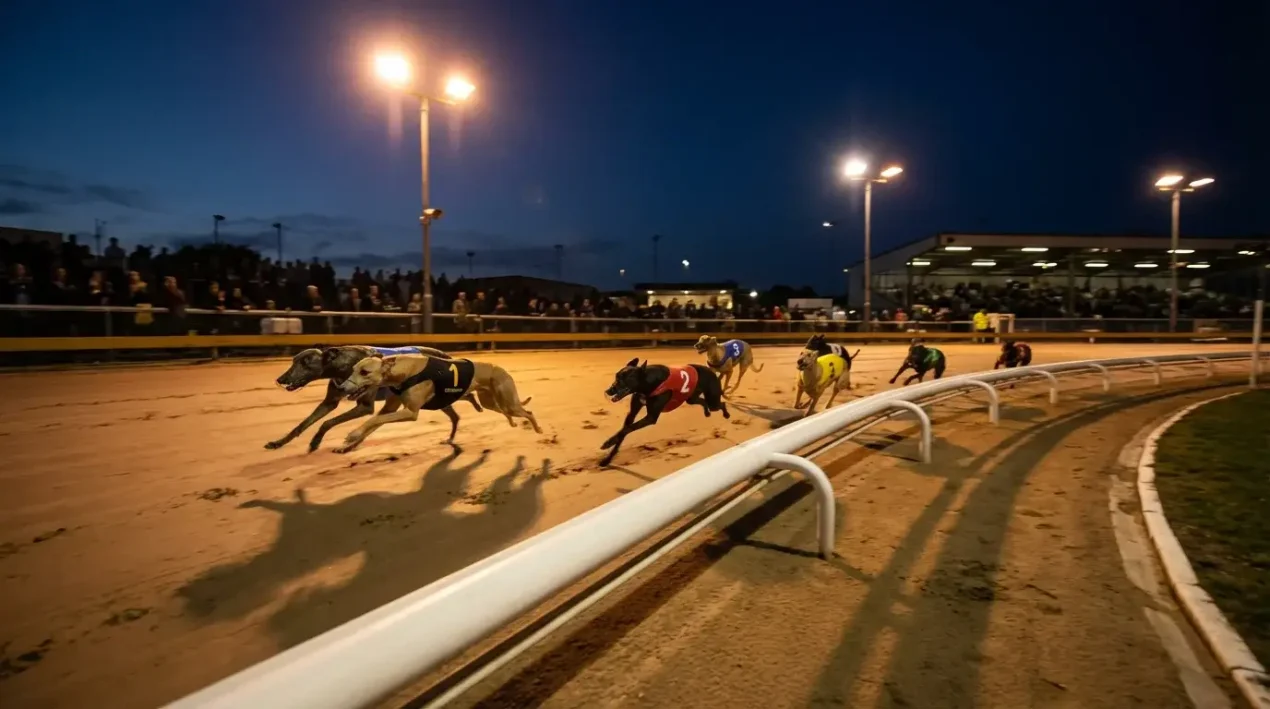
Six dogs, four bends, thirty seconds — greyhound racing strips betting down to its mechanical core. There is no jockey to second-guess, no draw bias complicated by a dozen runners, and no race that lasts long enough for tactics to unfold in any conventional sense. What you see on the form card is what you get on the sand. That directness is precisely why a greyhound betting system can work in ways that more complex sports resist.
Horse racing punters who migrate to the dogs often notice the difference within a single evening. Fields are capped at six. Races happen every fifteen minutes during a typical BAGS meeting. The variables — trap position, running style, early pace, track geometry — are finite and measurable. Unlike a Premier League match where seventy minutes of midfield congestion can separate a bet from its outcome, greyhound races compress everything into a sprint that leaves almost no room for random momentum swings. The dog that leads into the first bend wins more often than any statistic in horse racing allows for, and that pattern is consistent enough to be exploitable.
That is not the same as saying greyhound betting is easy. The speed of the market is ruthless. Early prices shift quickly, liquidity on exchanges is thin, and the sheer volume of daily races across the country means most punters spread themselves too thin. A sound greyhound betting strategy does the opposite: it narrows focus, demands discipline, and treats each race as a data event rather than an entertainment product. If you approach the dogs the way a card-counter approaches a shoe — patiently, selectively, and with an edge you can quantify — the sport rewards you with a frequency of opportunities that few other betting markets offer.
What is a betting system? A structured, repeatable method for selecting bets and managing stakes. It can be staking-based (controlling how much you wager), selection-based (controlling what you wager on), or a hybrid of both. A system is not a guarantee of profit — it is a framework for making decisions consistently, removing impulse from the process, and measuring results over a meaningful sample.
This guide covers the systems, analysis techniques, and market principles that experienced greyhound punters use to find value in UK racing. Some methods are mechanical, others require judgement, and all demand that you treat your betting bank as a finite resource and your time at the track as an exercise in probability rather than prediction.
Betting Systems: The Honest Assessment
No system prints money. Some, however, tilt the odds. That distinction matters more than any sales page will tell you, because the gap between a profitable greyhound betting system and a dressed-up coin flip is not the system itself — it is how, when, and whether you execute it.
Broadly, greyhound betting systems fall into three categories. Staking systems govern how much you bet: flat stakes, percentage-of-bank, progressive sequences. They say nothing about which dog to back — only how to size the wager. Selection systems do the opposite: they provide criteria for identifying runners with an edge, leaving the staking to you. Hybrid systems combine both, pairing a selection filter with a staking rule designed to maximise returns when the filter is working and minimise damage when it is not.
The honest truth is that staking systems alone cannot overcome a negative expectation. If your selections lose money at level stakes, no staking plan will rescue them over a meaningful sample. Selection-based systems, on the other hand, can genuinely shift the probability in your favour, provided they rest on verifiable data rather than gut feeling. The best greyhound betting strategies merge sound selection with disciplined staking, with the understanding that a five to eight percent return on investment over hundreds of bets is excellent — not disappointing.
No system guarantees profit. Greyhound racing involves interference, race-day condition changes, and market movements that no model fully captures. Systems provide structure, not certainty. Treat any seller who claims otherwise as a red flag, not a resource.
What follows is a breakdown of the most widely used approaches — their mechanics, their limitations, and the circumstances under which they earn their keep.
The Dutching Approach
Dutching doesn't pick winners — it hedges against picking losers. The principle is straightforward: back two or more runners in the same race, adjusting stakes so that whichever selection wins, the return is identical. You are not predicting a single outcome; you are covering a range of outcomes and locking in a profit margin across them.
The method works best in competitive greyhound races where form analysis points to two or three genuine contenders but cannot separate them. Rather than agonise over which of two 3/1 shots to back, a Dutching approach stakes on both, calculating the wager sizes so the total outlay is covered by any single winner. The maths is not complicated, but it needs to be precise. The core formula divides the total stake in proportion to each selection's implied probability.
To Dutch effectively, you need odds that offer collective value — meaning the combined implied probabilities of your selections must total less than one hundred percent after accounting for the bookmaker's margin. In a six-dog race, the theoretical fair probability for each runner is 16.7%. If you identify two dogs whose true chances exceed their market prices, Dutching captures that edge without forcing you to choose between them. If the combined implied probability of your two picks exceeds your assessed true probability, there is no value to capture and the Dutch becomes a structured way of losing slowly.
Dutching Two Selections: Stake Calculation
Total budget: £20. Dog A is priced at 3/1 (implied probability 25%). Dog B is priced at 4/1 (implied probability 20%). Combined implied probability: 45%.
Stake on Dog A: £20 x (25% / 45%) = £11.11
Stake on Dog B: £20 x (20% / 45%) = £8.89
If Dog A wins at 3/1: return = £11.11 x 4 = £44.44. Profit = £24.44.
If Dog B wins at 4/1: return = £8.89 x 5 = £44.45. Profit = £24.45.
Equal return regardless of which selection wins. If neither wins, the full £20 is lost.
The trap most Dutch bettors fall into is over-coverage. Dutching three or four runners in a six-dog race might feel safe, but the margin compresses rapidly. By the time you cover four of six, the bookmaker's overround wipes out your edge. Restrict Dutching to two, occasionally three, selections where your form analysis gives genuine confidence — and accept that races where you cannot narrow the field are races to skip.
Progressive Staking: Martingale and Beyond
Martingale has bankrupted more punters than bad tips ever could. The system is disarmingly simple: after every losing bet, double your stake so that the next winner recovers all previous losses plus one unit of profit. On paper, it works. In practice, it requires an infinite bankroll, no table limits, and a universe where losing streaks have a maximum length. None of those conditions exist at a greyhound track.
Consider a sequence starting at £5 on even-money shots. After six consecutive losses — which happens far more often than most people intuit — the next required stake is £320, for a cumulative outlay of £635. A seventh loss pushes the stake to £640. An eighth demands £1,280. The progression is exponential, and greyhound racing produces losing runs of eight or more with uncomfortable regularity, particularly if you are backing short-priced favourites whose true win rate hovers around 30-35%. The Martingale does not respect your bank balance, and neither does variance.
Alternatives exist. The Fibonacci sequence (1, 1, 2, 3, 5, 8, 13...) escalates more slowly, moving up after a loss and dropping back two places after a win. The Labouchere system uses a number line, adding the first and last numbers to determine the stake and crossing off numbers after wins. The D'Alembert adds one unit after a loss and subtracts one after a win. All three are gentler than Martingale, but they share the same flaw: they assume future results will correct past variance, which is not how independent events work. Each greyhound race is a fresh trial.
Do
- Use level stakes or percentage staking as your default approach
- Test any staking plan on paper for at least 200 bets before committing real money
- Set a hard stop-loss that prevents any single session from destroying your bank
- Track results honestly, including the full cost of progressive sequences
Don't
- Chase losses by doubling stakes after a bad run
- Assume that a losing streak must end soon because of probability
- Use progressive staking to compensate for poor selection criteria
- Ignore the mathematical certainty that exponential growth outpaces any finite bank
If you find progressive staking appealing, ask yourself a blunt question: would your selections be profitable at flat stakes? If the answer is no, progressive staking will not fix them — it will merely delay and amplify the eventual loss. If the answer is yes, flat staking already works, and adding progression introduces unnecessary risk to a winning formula.
Data-Driven Selection Systems
Numbers don't lie, but they don't tell the whole story either. Data-driven greyhound betting systems use measurable variables — trap statistics, sectional times, grade movements, form cycles — to identify runners whose chance of winning exceeds the probability implied by their market price. The approach demands more work than staking systems, but it is the only category that can genuinely shift the mathematical expectation in your favour.
The simplest data-driven method is trap bias analysis. Every UK track has geometric quirks — the bend radius, the position of the hare rail, the camber of the surface — that favour certain traps over time. At some venues, trap one wins significantly more than the expected 16.7% share across hundreds of races. If you can identify those biases and cross-reference them with the draw, you have a filter that narrows the field before you even look at form. The data is publicly available through specialist services and the Racing Post's greyhound section, and it updates with every meeting.
Sectional time analysis adds another layer. By comparing a dog's run-up time (the split to the first bend) with its overall finishing time, you can separate early-pace merchants from strong finishers. A dog that consistently posts fast sectionals from trap one at a track where first-bend advantage is statistically decisive is a different proposition from the same dog drawn in trap six. Combining sectional data with trap bias creates a two-factor model that is basic but effective.
More sophisticated systems incorporate grade drops (dogs descending from higher grades into weaker races), trainer form (kennel strike rates at specific tracks), and form cycles (the pattern of improvement or decline across a dog's recent runs). Building your own model requires a spreadsheet, a source of historical results, and the patience to record enough data for the patterns to be statistically meaningful — typically several hundred races at a single track. The payoff is a system that is genuinely yours, tuned to the venues you know, and impossible for the market to front-run because nobody else is running the same numbers.
Reading Greyhound Form
Form is biography compressed into abbreviations. Every greyhound racecard tells you where a dog ran, when it ran, how fast it ran, where it was at every checkpoint, what happened at the bends, and how it finished — all in a few lines of shorthand that look like encrypted text until you learn to decode them. Mastering greyhound form analysis is the single most important skill in the sport, because it is the raw material from which every selection decision flows.

A standard form card shows the dog's recent runs in reverse chronological order, typically the last six outings. Each line includes the date, track, distance, grade, trap number, the dog's position at key checkpoints, the finishing time, the sectional time, and a comment compressed into abbreviations: EP (early pace), SAw (slow away), Crd (crowded), Led1 (led from the first bend). The positional data is where most of the analytical value sits. A dog recorded as 1-1-1 led throughout; a dog showing 6-5-2 was last early but closed strongly, suggesting a closer who may benefit from a different trap draw next time. The pattern across multiple runs reveals style and consistency far more reliably than any single result.
Recent Form Figures
The shorthand sequence (e.g., 321145) shows finishing positions across the last six runs. Read left to right, most recent first. Consistency matters more than a single win — a dog showing 222232 is a reliable place contender.
Sectional and Finishing Times
The split time measures pace to the first bend; the finishing time covers the full distance. Compare both against the track standard for the grade. A fast sectional with a slow finish suggests a dog that fades. A slow sectional with a fast finish signals closing ability.
Trap and Running Style
Form cards note which trap the dog ran from and its positional abbreviations (R = railer, M = middle runner, W = wide runner). Cross-reference the running style with the trap draw in the current race to assess whether the dog is favourably positioned.
Grade and Distance
Each run lists the race grade (A1 through A11, plus Open and puppy categories) and distance. A dog dropping in grade is meeting weaker opposition — a positive signal. A dog stepping up in distance may not stay. Context is everything.
The Racing Post and specialist greyhound form services publish cards with full comment lines, trainer statistics, and track-specific data. Reading them fluently takes practice — start with one track, follow the same dogs across multiple meetings, and correlate what the form card tells you with what you see on screen or at the venue. Within a few weeks, the abbreviations become a language you read without thinking. One common mistake among beginners is over-weighting the most recent run. Greyhound form is volatile — a single crowding incident can produce a result that reveals nothing about true ability. Look at four to six runs, focus on sectional time consistency rather than finishing positions, and always factor in trap draw and grade context.
Sectional Times Decoded
The first bend decides most races before the crowd has exhaled. Greyhound racing is front-running territory — the dog that reaches the first bend in front avoids the crowding, the checking, and the wide running that costs lengths and races. Sectional times quantify that advantage with precision, and they are the single most predictive data point available to punters who are willing to dig into the numbers.
A sectional time — sometimes called a split time or run-up time — measures the elapsed time from trap opening to the first timing beam, typically positioned near the first bend. At a standard 480-metre track, a fast sectional might be 4.40 seconds; an average one 4.60; a slow one 4.80 or above. Those fractions of a second translate into lengths, and lengths translate into clear running or crowded bends.
Fast Sectional
Below 4.45 seconds over standard sprint distance. Indicates a sharp trapper likely to lead into the first bend. Most valuable from inside traps at tracks with tight bends.
Average Sectional
Between 4.45 and 4.65 seconds. The dog may or may not lead, depending on the pace of rivals. Position at the first bend is a coin flip without further context.
Slow Sectional
Above 4.65 seconds. A confirmed slow starter. Needs a clear run from an outside trap or an exceptional finishing kick to overcome early positional disadvantage.
The predictive power of sectionals increases when you compare them within the context of a specific track and grade. A 4.50-second split at Romford's tight 350-metre circuit has different implications than the same split at Towcester's wide 500-metre oval. Always benchmark against the track average for the distance and grade, not against an abstract ideal. The dog with the fastest sectional relative to its usual rivals is the one most likely to lead, and the one most likely to lead is, statistically, the one most likely to win.
Running Styles and Trap Draw
A railer in trap six is a contradiction waiting to unravel. Greyhound running styles are not preferences — they are biomechanical habits baked into the dog's physiology and training. A railer hugs the inside rail because it naturally drifts left on bends. A wide runner sweeps right because its stride or cornering technique pushes it outward. Matching running style to trap draw is one of the simplest and most consistently profitable edges in greyhound betting, and it costs nothing more than reading the form card properly.
Railers (annotated as R on form cards) want inside traps — one, two, or occasionally three. From these positions, they can break, hug the rail, and take the shortest route around the bends with minimal interference. A railer drawn in trap five or six must cross the path of other runners to reach the rail, losing ground and inviting trouble. Wide runners (W) face the opposite problem: they need outside draws to avoid being boxed in on the rail and forced to check. Middle runners (M) are the most adaptable but also the hardest to predict, since their path depends heavily on what happens around them at the first bend.
The practical application is immediate. When studying a race card, note each dog's running style and compare it to the trap draw. If a confirmed railer is drawn in trap one against a field of middle runners and wide runners, the positional advantage is structural — the dog has a clear rail and no rival will contest it. If two railers are drawn in traps one and two, expect crowding at the first bend. If a wide runner is drawn in trap one, it will either fight its instincts or drift wide from a poor position, neither of which is ideal. These mismatches are visible before the race starts and are underpriced by the market more often than you might expect.
Trap Bias: The Hidden Edge
Some traps win more than probability allows — and the stats prove it. In a perfectly balanced six-dog race, each trap would win 16.7% of the time. Real tracks are not perfectly balanced. The geometry of the run-up, the radius of the first bend, the position of the hare rail, the camber of the surface, and even the prevailing wind direction create structural advantages that persist across hundreds of races and show up clearly in the data.
Trap bias is the statistical tendency of certain starting positions to produce more winners than random chance predicts. At tracks with tight first bends and short run-ups, inside traps (one and two) tend to dominate because the shortest path to the bend is also the least congested. At tracks with wider bends and longer straights, outside traps perform closer to expectation because there is more time and space for dogs to find their position before the crowding begins.
The edge comes from combining trap bias with market prices. Bookmakers set odds based on the individual dog's form, but they do not always fully adjust for the trap-specific win rate at a given venue. If trap one at a particular track wins 22% of races over a twelve-month sample, and the dog drawn in trap one is priced at odds implying a 15% chance, the gap between the actual and priced probability is your edge. It is a small edge — typically a few percentage points — but across hundreds of bets, small edges compound into meaningful profit.
Interactive Tool
Trap Bias Edge Calculator, and Martingale Multiplier
Turn "your edge" into an exact percentage-point gap, and see how many multiples of your starting stake a losing run actually demands.
Edge (Percentage Points)
-
-
Actual Trap Win %
-
Implied by Odds
-
Ratio
-
What this guide calls "your edge" without a number: "If trap one at a particular track wins 22% of races... and the dog drawn in trap one is priced at odds implying a 15% chance, the gap between the actual and priced probability is your edge." The figure is never stated — the exact edge is 7 percentage points, meaning the trap wins 1.47x as often as the market prices it to.
Next Bet as Multiple of Start
-
-
Starting Stake
-
Next Bet Amount
-
Cumulative Outlay
-
What this guide gives as pounds but never as a multiple: "the next required stake is £320... An eighth demands £1,280." The sequence is shown, but never expressed relative to the starting stake — after 6 losses, the next bet is 64x your original stake; after 8 losses, it is 256x.
Inside Traps — Traps 1 and 2
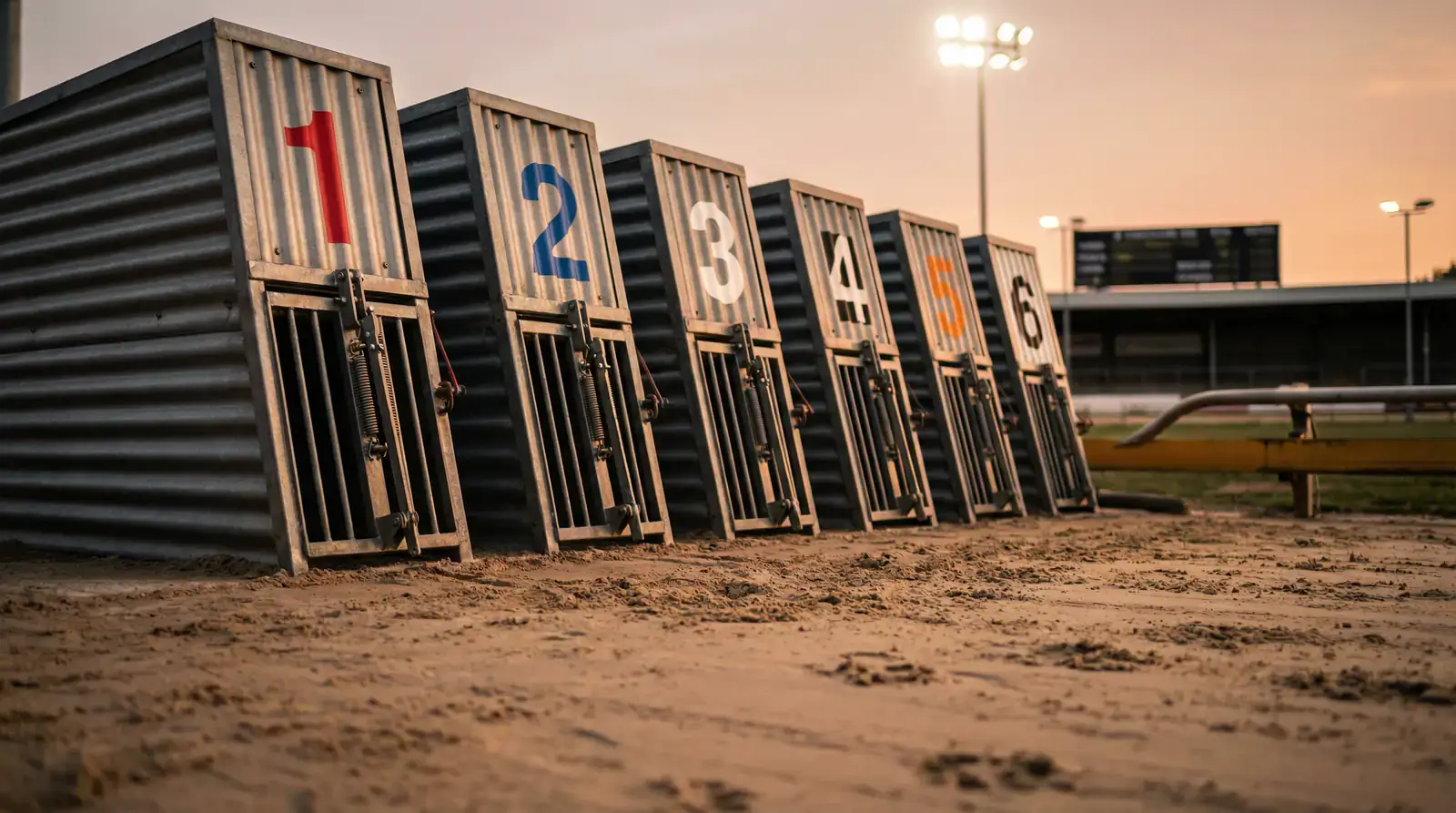
Statistically favoured at tracks with tight bends and short run-ups. Railers thrive here. The rail provides a physical guide, and the shortest distance around the bend translates into fewer lengths lost. The downside: crowding when two fast breakers are drawn side by side. Inside trap advantage is highest at compact tracks like Romford and the now-closed Crayford.
Outside Traps — Traps 5 and 6
More competitive at tracks with sweeping bends and longer straights, where early pace matters less and wide runners have room to operate. Trap six can produce surprise winners in races where the inside is congested. The downside: the dog covers more ground on every bend, which adds up over four bends. Outside traps rarely outperform inside traps on aggregate, but the gap is smaller than most punters assume.
Accessing trap bias data is straightforward. Specialist sites publish cumulative trap statistics by track, distance, and period. What matters is the sample size — use at least 500 races at a given track and distance before treating the bias as reliable. And review quarterly: track maintenance, weather shifts, and hare system changes can all alter the pattern.
Weather and Track Conditions
Wet tracks rewrite the form book overnight. Rain changes the surface grip, the running rail's effectiveness, and the relative advantage of different traps in ways that dry-weather form cannot predict. A dog that posts fast sectionals on firm sand may struggle on a waterlogged surface where traction is poor and stride frequency drops. Conversely, some dogs handle wet conditions naturally — typically heavier animals with a lower centre of gravity and a more measured running style.
The primary effect of rain is on inside traps. Water drains toward the inside rail, making the path along the rail heavier and slower. Railers who normally benefit from the shortest distance now face the slowest surface. Outside traps gain a relative advantage because the outer part of the track dries faster and offers better footing. If your system relies on trap bias data collected predominantly in dry conditions, a wet meeting can invalidate the model entirely. Serious greyhound bettors track weather conditions at their target venues and maintain separate bias data for wet and dry meetings.
Dry, hard conditions produce the opposite effect. Fast surfaces favour early-pace dogs because the ground is firm and responsive. Finishing times drop, and first-bend advantage is amplified. Wind is a subtler factor but relevant at exposed venues — a headwind on the back straight compresses the field and gives closers a chance; tailwinds stretch it and reinforce the front-runner.
The practical rule: check the weather before you bet, and if conditions have changed since the most recent form entries, adjust accordingly. A dog's last three runs on dry sand tell you nothing about a sodden Tuesday evening. Flexibility is not optional.
Understanding Your Betting Options
Every bet type serves a purpose — know yours before you stake. Greyhound racing offers a range of betting markets, from the straightforward win bet to the exotic tricast, and each suits a different level of confidence, a different risk appetite, and a different analytical approach. Choosing the wrong bet type for the situation is as costly as choosing the wrong dog.
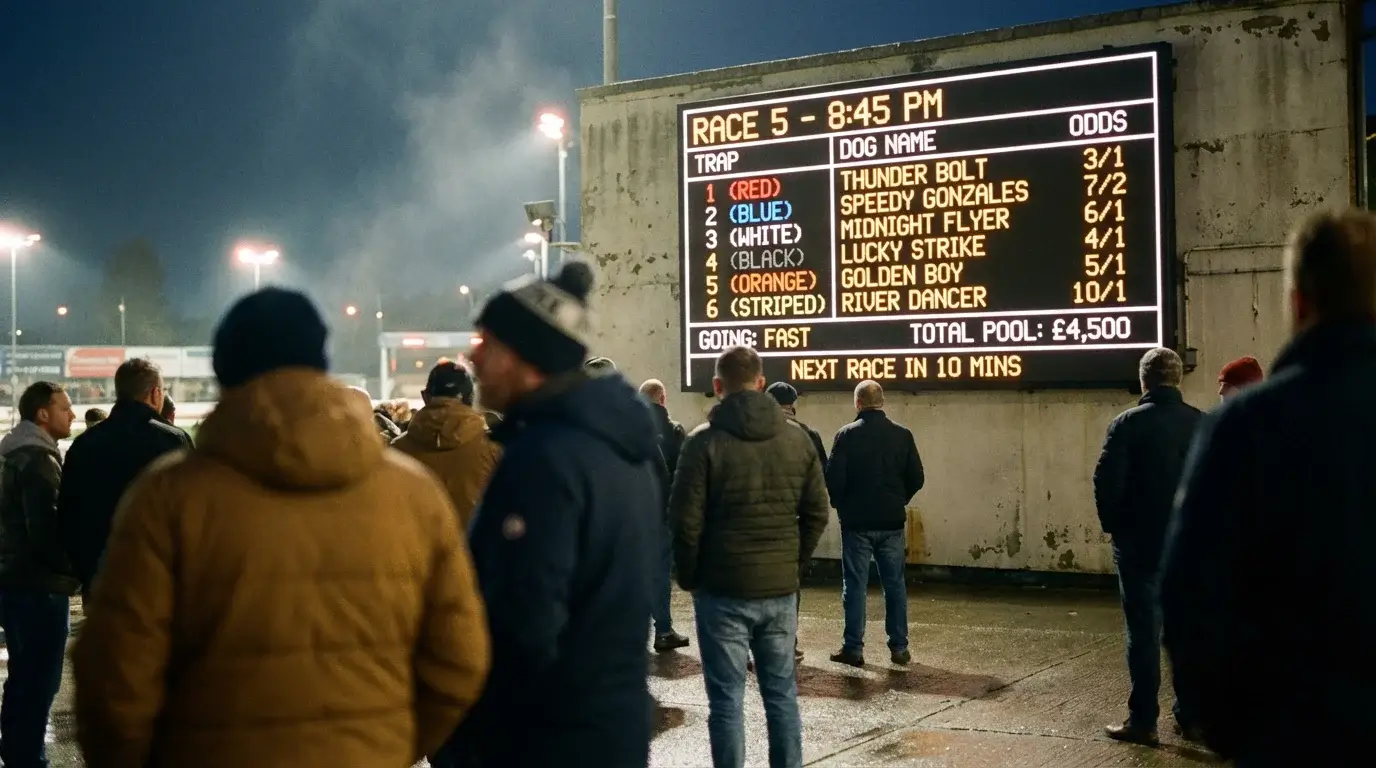
The win bet is the foundation. You back a dog to finish first. If it wins, you collect; if it does not, you lose your stake. The simplicity is the point: win betting forces you to have genuine conviction about a single outcome, and it is the only bet type where your edge is directly measurable over time. If you cannot show a profit at level stakes on win bets, adding complexity will not help.
Place betting relaxes the requirement — your dog needs to finish first or second (in a six-runner race, the standard place terms). The odds are lower, typically a quarter or a third of the win price, but the strike rate is higher. Each-way betting combines both: it is two bets in one, a win bet and a place bet at equal stakes. If the dog wins, both bets pay. If it finishes second, you lose the win half but collect on the place half. Each-way value appears most often at longer odds — a 6/1 shot finishing second returns a place dividend that more than covers the losing win portion, giving you a net profit on what looks like a losing bet.
Each-Way Bet Example
Dog priced at 5/1. You stake £5 each-way (total outlay: £10 — £5 win, £5 place at 1/4 odds).
If the dog wins: Win return = £5 x 6 = £30. Place return = £5 x 2.25 = £11.25. Total return: £41.25. Profit: £31.25.
If the dog finishes second: Win bet loses (−£5). Place return = £5 x 2.25 = £11.25. Total return: £11.25. Profit: £1.25.
If the dog finishes third or worse: Both bets lose. Loss: £10.
Beyond the basics, greyhound betting offers forecast and tricast markets for punters who can predict finishing order. Tote pools aggregate stakes and distribute dividends after each race, occasionally producing larger payouts than fixed-odds bookmakers. Betting exchanges allow you to lay dogs — betting against them — which opens a different strategic dimension. Each market rewards the punter who understands what they are doing before the bet is placed, not after.
Forecasts and Tricasts
Combination bets multiply possibilities — and stakes. A forecast bet requires you to predict the first two finishers in a race. A tricast extends the challenge to the first three. The payouts can be substantial, particularly in competitive races where the result is hard to predict, but the difficulty — and the cost of covering your options — scales rapidly.
A straight forecast names two dogs in exact finishing order: Dog A first, Dog B second. A reverse forecast covers both permutations at twice the stake. A combination forecast selects three or more dogs and covers every possible pairing — three dogs generate six bets, four dogs generate twelve. Tricasts follow the same logic with three finishing positions: a combination tricast with three dogs is six bets, with four dogs twenty-four.
The cost arithmetic matters. If your unit stake is £1, a combination forecast on three dogs costs £6; a combination tricast on four dogs costs £24. Before placing the bet, calculate whether the expected dividend justifies the outlay. In low-grade races with competitive fields, forecast dividends can exceed £50, making the combination cost worthwhile. In top-grade races where form clearly points to two strong dogs, the dividend may be only £8 or £10, and covering all permutations makes no financial sense.
Before Placing a Forecast or Tricast
- Count the total number of bets in your combination and multiply by your unit stake — that is your true outlay
- Estimate the minimum likely dividend using the current odds of your selections
- Confirm that the estimated dividend exceeds your total outlay by a meaningful margin
- Check whether each selection has a genuine reason to finish in the required position, not just a general chance of being involved
- Consider whether a simpler win or each-way bet on your strongest selection offers better expected value
Forecasts and tricasts reward punters who can identify the likely principals in a race and assess their finishing order. The best forecast bettors focus on races where the field divides clearly into contenders and non-contenders, using exotic markets to extract a higher return from an opinion they already hold rather than as a substitute for having an opinion at all.
Finding Value in the Market
Value isn't about winners — it's about price relative to chance. A dog that wins at 1/3 is not a value bet unless its true probability of winning exceeds 75%. A dog that loses at 8/1 is not a bad bet if its true probability of winning was 15% — because at that price, backing it repeatedly would produce a long-term profit. Understanding value is the conceptual leap that separates recreational punters from systematic ones, and it is the foundation of every profitable greyhound betting system.
The mechanism is straightforward. Every set of odds implies a probability. Odds of 3/1 imply a 25% chance. Odds of evens imply 50%. If your analysis suggests the true probability is higher than the implied probability, the bet has positive expected value. Over a large sample of bets, positive expected value translates into profit, regardless of any individual result. The challenge, obviously, is assessing the true probability more accurately than the bookmaker — and on that point, greyhound racing offers punters a genuine advantage.
Bookmaker pricing in greyhound markets is less sophisticated than in football or horse racing. The volume is lower, the analytical coverage is thinner, and many prices are set by algorithm rather than by a dedicated odds compiler. The market can be slow to reflect track-specific information like trap bias, surface conditions, or kennel form. If you specialise in a single track and build your own data set, you will regularly spot prices that underestimate a dog's true chance.
Keep a spreadsheet that records your assessed probability alongside the market price for every bet you consider. Over time, this log reveals whether your estimates are accurate and where they are systematically wrong. If your 25%-rated dogs win 30% of the time, your model is underpricing them. If they win 18%, recalibrate.
Timing Your Bets
The right price at the wrong time is still the wrong bet. Greyhound markets move, and understanding the rhythm of those movements is a practical edge that costs nothing to acquire. Early prices are typically available from mid-morning for evening meetings and from the night before for afternoon BAGS cards. The starting price (SP) is determined at race-off from the on-course market — or, more accurately, from the aggregate of bookmaker positions at that moment.
Early prices tend to be more generous for dogs whose form is strong on paper but who draw awkward traps or face unknown conditions. Bookmakers offer value early because they want to attract money to balance their books; by the time the market matures, sharp money has corrected the biggest mispricings. If your analysis identifies value in the morning price, take it. Waiting for the SP in the hope of a better number usually works against you, because the SP reflects the weight of opinion from everyone who has studied the race — including professionals.
The exception is Best Odds Guaranteed (BOG). Many UK bookmakers offer BOG on greyhound racing, meaning that if you take an early price and the SP is higher, you receive the SP instead. This effectively removes the downside of betting early. With BOG, the optimal strategy is clear: take the early price whenever it represents value, knowing that any market drift in your favour will be captured automatically. Check the terms carefully, though — some bookmakers restrict BOG to specific meetings or exclude BAGS races.
Exchange betting introduces different timing considerations. Liquidity in greyhound markets on Betfair and similar platforms is thin until close to race time. If backing on an exchange, wait until the market forms — usually within five to ten minutes of the off. If laying, earlier can be better, since prices tend to shorten as the race approaches.
Protecting Your Betting Bank
Your bank is your oxygen — protect it or suffocate. Every greyhound betting strategy, no matter how elegant, is worthless without a bankroll to execute it. The dogs that lost today do not know or care that your system has a positive expected value over a thousand bets. If your bank is gone after fifty, the remaining nine hundred and fifty are theoretical. Bankroll management is not the glamorous part of betting, but it is the part that determines whether you are still betting next month.
Level staking is the simplest and most effective approach for most punters. Set a unit stake — typically one to two percent of your total bank — and bet the same amount on every selection, regardless of confidence level. The appeal of increasing stakes on "strong fancies" is natural but dangerous, because your perception of confidence does not reliably correlate with actual probability. If your selections are genuinely profitable at level stakes, consistency will compound. If they are not, varying your stake will only accelerate the damage.
Percentage staking adjusts the unit to your current bank balance. If your bank is £500 and your unit is 2%, you bet £10. If the bank grows to £600, the unit rises to £12. If it drops to £400, the unit falls to £8. The advantage is automatic scaling — you press harder when winning and retreat when losing, without any conscious decision. The disadvantage is that during losing runs, the ever-shrinking stake makes recovery slower, which tests patience more than any losing bet.
Set loss limits before you bet, not during. Decide in advance how much you are prepared to lose in a session, a week, and a month. When you hit the limit, stop. No exceptions. The urge to chase losses is the single most common cause of bankroll destruction, and it operates most powerfully in the exact moment when your judgement is least reliable. Write the limits down. Pin them to your screen. Treat them as non-negotiable.
Track every bet. Record the date, race, selection, trap, odds taken, stake, result, and profit or loss. After a hundred bets, your records will show your strike rate, return on investment, and which tracks or race types are producing profit versus draining it. Without records, you are guessing. With them, you are managing.
Know when to stop. Gambling should be an activity you enjoy and can afford. If your bank is money you need for bills or dependents, it is not a betting bank. If chasing losses has become habitual, step back. Resources like GamCare and GambleAware offer free, confidential support.

UK Greyhound Racing Landscape
Eighteen GBGB-licensed stadia operate across England and Wales, and racing takes place almost every day of the year. The sport marks its centenary in 2026 with an expanded programme of 50 Category One competitions and 27 Category Two events spread across the calendar — a schedule that reflects both the enduring appeal of greyhound racing and the industry's push to celebrate a hundred years of British track heritage.
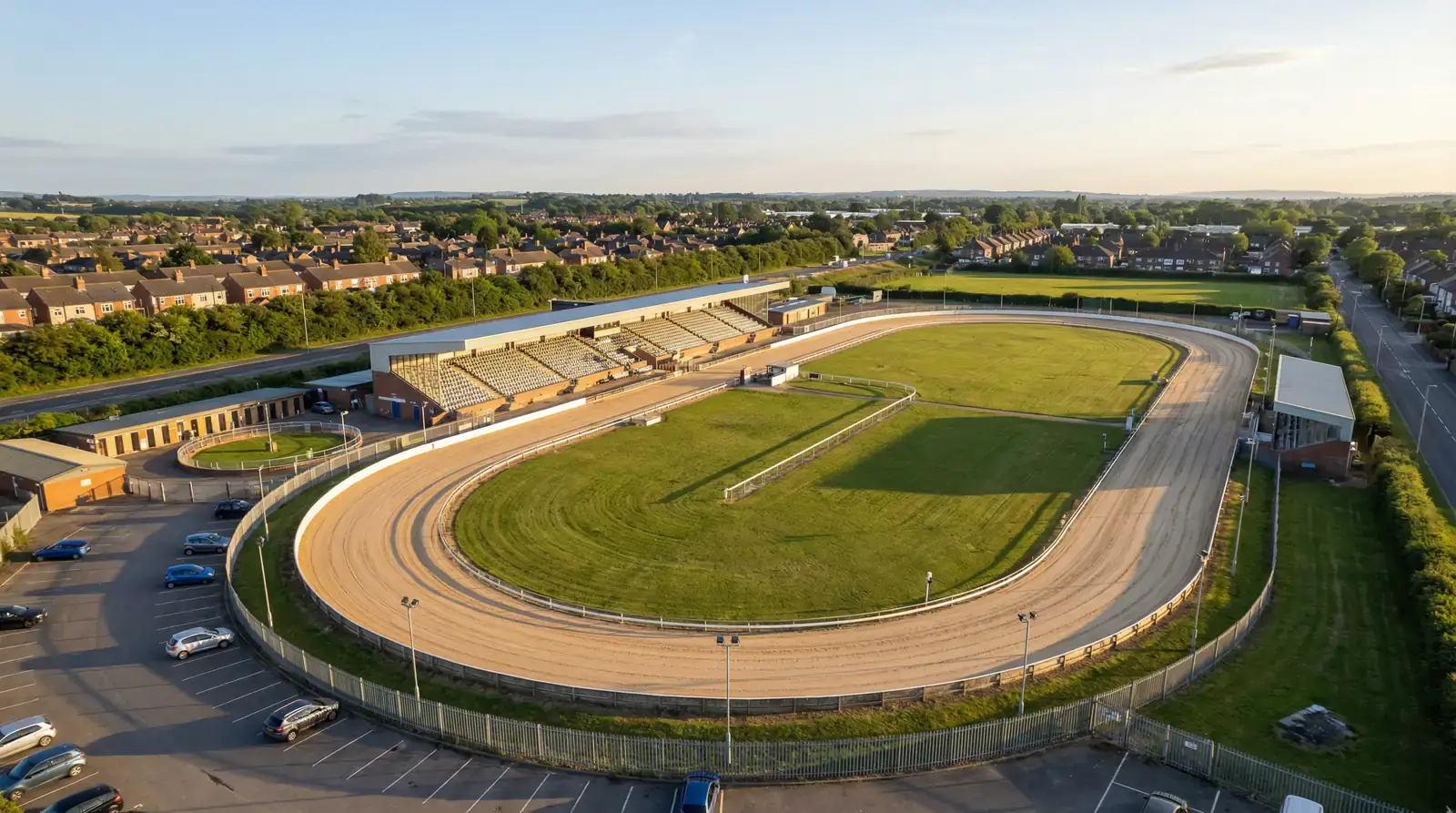
For bettors, the most relevant distinction is between tracks you specialise in and tracks you do not. Romford, a tight 350-metre circuit in east London, races several times a week and produces results heavily influenced by trap draw and early pace. Crayford, the southeast London venue that closed in January 2025, was another high-frequency venue with a distinctive track geometry that rewarded inside traps. Nottingham, Monmore Green in Wolverhampton, and Perry Barr in Birmingham offer different configurations, different surfaces, and different biases. Towcester, the Northamptonshire venue that hosts the English Greyhound Derby from April through June, has a wider galloping track that suits strong-running dogs over 500 metres — the 2026 Derby final on June 6 carries a first prize of £125,000, making it the richest and most prestigious event on the calendar.
BAGS (Bookmakers' Afternoon Greyhound Service) meetings provide the bulk of daily racing, broadcasting into betting shops and online platforms. These cards feature graded races from A1 through A11, plus puppy, hurdle, and marathon categories, generating the data volume that systematic bettors rely on. Open races attract the highest-quality fields and the sharpest prices.
The strategic advice for any punter building a greyhound betting system is to pick one track and master it. Learn its trap biases across different distances. Understand which trainers are based locally. Study how the surface behaves in different weather. Watch streams regularly enough that you recognise individual dogs, notice grading changes, and spot patterns that only reveal themselves through repetition. Eighteen tracks mean eighteen personalities. Spreading your attention across all of them is a recipe for mediocrity. Concentrating on one is the first step toward an edge.
Frequently Asked Questions
Do greyhound betting systems guarantee profits?
No system guarantees profit. Greyhound racing involves unpredictable variables — dog temperament, race-day interference, surface changes, and market movements that no model captures completely. What a sound system provides is structure: a repeatable method for identifying bets with positive expected value and managing stakes to survive the inevitable losing runs. Disciplined application of trap bias analysis, form reading, and bankroll management can deliver a statistical edge over hundreds of bets, but that edge is measured in single-digit percentage points of return on investment, not in guaranteed income. Realistic expectations and consistent execution matter far more than the system itself.
How do I identify trap bias at specific UK tracks?
Trap bias data is published by specialist greyhound statistics services and in the Racing Post's greyhound section. Look for traps with win percentages significantly above the theoretical 16.7% baseline for six-runner races, using a sample of at least 500 races at the track and distance you are analysing. Smaller samples can be misleading. Combine the statistical bias with your form assessment — when a trap that historically outperforms holds a dog with strong form and a suitable running style, confidence increases. Revisit the data regularly, because bias can shift after track maintenance, weather changes, or alterations to the hare system. Wet and dry conditions often produce different bias patterns at the same track, so maintaining separate data sets for each is worthwhile.
What is the difference between SP and early prices in greyhound betting?
SP (Starting Price) is the final odds at race-off, derived from the on-course betting market at the moment the traps open. Early prices are offered by bookmakers hours before the race, often from mid-morning for evening meetings. Early prices can offer better value if you anticipate that a dog's odds will shorten as more money enters the market. The key tool for UK greyhound bettors is Best Odds Guaranteed (BOG), offered by many bookmakers: if you take an early price and the SP turns out higher, you receive the SP instead. With BOG, taking the early price is almost always the optimal strategy because you capture any drift in your favour without risking a worse return. Check individual bookmaker terms, as some restrict BOG to certain meetings or race types.
The Edge That Compounds
The house edge is small. Yours can be smaller still — if you are patient. Greyhound betting systems are not shortcuts and not secrets. They are frameworks for making consistent decisions in a sport that rewards consistency above all else. The punter who backs one well-researched selection per evening, at the right price, from a position of genuine knowledge about the track, the dogs, and the conditions, will outperform the punter who fires at every race with a different theory each time. Not because the first punter is smarter, but because the first punter has eliminated the noise.
The centenary season of British greyhound racing, with its packed calendar of Category One events and the Derby at Towcester commanding the late spring, is as good a time as any to start — or to refine — a systematic approach. But the calendar is not the point. The point is that the edge in greyhound betting is not a single insight. It is the accumulation of small advantages: a trap bias identified and tracked, a sectional time pattern that the market has not priced in, a running style mismatch that tells you a dog is drawn wrong before the traps open. Individually, none of these advantages is decisive. Together, applied with discipline over months and years, they compound.
Every system in this guide has limitations. Dutching works until the overround swallows your margin. Form reading works until a dog has an off-day. Trap bias works until the track is resurfaced. The punter who survives is the one who expects those failures, budgets for them, and returns to the data without bitterness or urgency. Discipline is not glamorous. Neither is compound interest. But both, given time, are remarkably effective.
