
Laying Greyhounds: Betfair Exchange Strategy Guide
 Available in US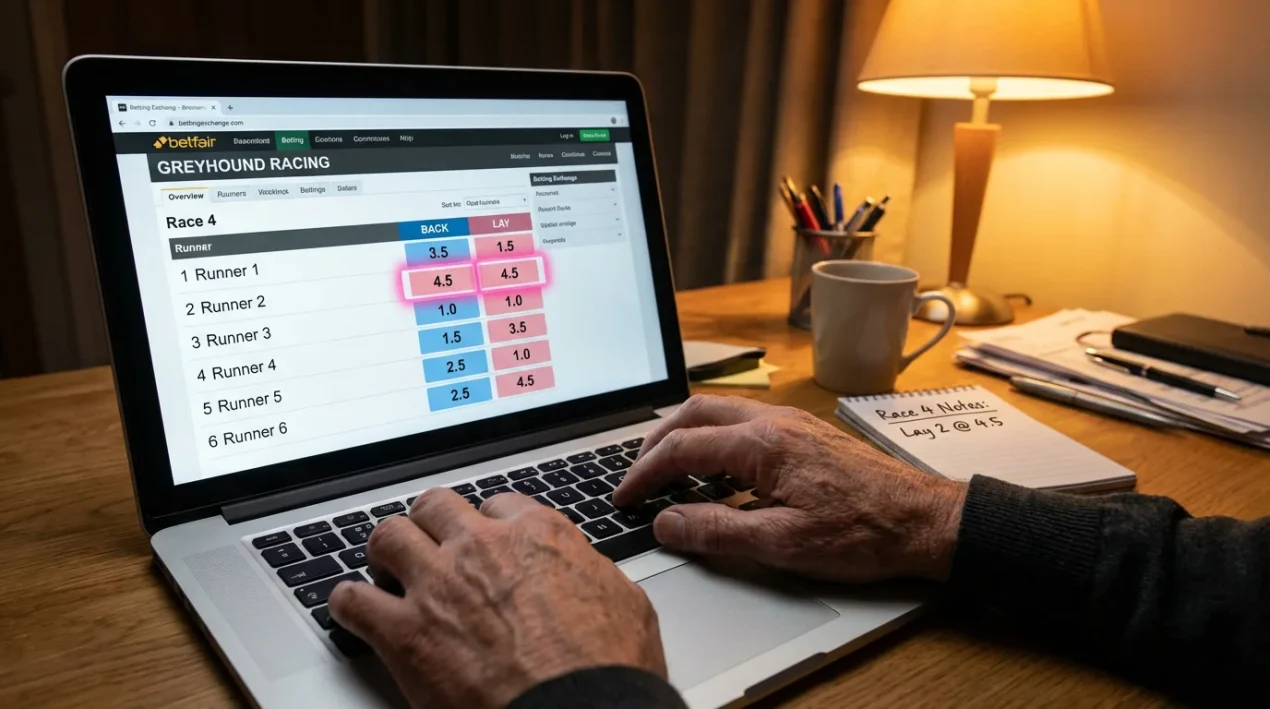
Contents
Traditional betting is straightforward: you pick a dog to win and back it. Laying is the opposite. When you lay a dog, you are betting that it will not win. You take the role of the bookmaker, offering odds to someone who wants to back that dog, and you profit if the dog finishes anywhere other than first. In a six-dog greyhound race, a lay bet gives you five chances to win and only one to lose. That ratio appeals to a lot of punters, and with good reason. Find more strategy guides at greyhoundbettingsystem.
Laying is only available on betting exchanges — platforms like Betfair and Smarkets where punters bet against each other rather than against a bookmaker. The exchange takes a commission on winning bets, typically between 2 and 5 percent, and the rest of the transaction is between the backer and the layer. For greyhound racing, laying opens up an entirely different analytical approach: instead of asking “which dog will win?” you ask “which dog definitely will not win?” That question is often easier to answer.
How Laying Works on an Exchange
When you place a lay bet, you are offering to pay out if the dog wins, in exchange for keeping the backer’s stake if it loses. Your potential profit is the backer’s stake minus the exchange commission. Your potential loss is determined by the odds at which you laid the dog.
Suppose you lay a dog at odds of 4.0 (3/1 in fractional terms) for a backer’s stake of ten pounds. If the dog loses, you keep the ten pounds minus commission. If the dog wins, you pay out thirty pounds (the backer’s winnings at 3/1). Your liability — the maximum you can lose — is thirty pounds. The backer risks ten to win thirty. You risk thirty to win ten minus commission.
This asymmetry is the defining feature of laying. Your wins are smaller and more frequent. Your losses are larger but less frequent. In a six-dog race, if you lay a dog at 4.0 and your assessment is that it genuinely has a 25 percent chance of winning, you will win 75 percent of the time and lose 25 percent of the time. Over a large sample, the mathematics favour the layer, provided the odds and probabilities are correctly assessed.
The exchange commission reduces your profit on winning bets, which means the margins are tighter than they first appear. At a 5 percent commission rate, a ten-pound lay win nets you 9.50 rather than 10.00. Over thousands of bets, that commission adds up significantly and must be factored into any profitability calculation.
Unlike backing with a bookmaker, where the maximum loss is your stake, laying carries a liability that can exceed your stake substantially. Laying a dog at 10.0 (9/1) for a ten-pound back stake means your liability is ninety pounds. If the dog wins, you lose ninety. If it does not, you gain ten minus commission. The potential loss is nine times the potential gain, which is why laying at long odds requires extreme confidence that the dog will not win.
Managing Your Liability
Liability management is the most critical skill for any greyhound layer. Unlike backing, where you know your maximum loss the moment you place the bet, laying requires you to calculate and control the potential downside before committing.
The golden rule is to lay at short odds. Laying a dog at 2.0 (evens) means your liability equals the backer’s stake — a one-to-one risk-reward ratio. Laying at 3.0 means your liability is double the backer’s stake. Laying at 6.0 means your liability is five times the backer’s stake. As the odds increase, the liability grows faster than the potential profit, and the risk-reward equation deteriorates rapidly.
Most successful greyhound layers concentrate on laying at odds between 1.5 and 3.5. Within this range, the liability is manageable and the profit-per-bet is reasonable. Beyond 4.0, the liability becomes disproportionate to the reward, and a single losing lay can wipe out several winning ones. Setting a maximum lay price as part of your rules and never exceeding it is a simple discipline that prevents the most common form of laying catastrophe.
Bank allocation matters just as much for laying as for backing. Your laying bank should be able to absorb a series of losing lays without being depleted. If your maximum liability per lay is fifty pounds, your bank should be large enough that five or six consecutive losses do not eliminate you. A bank of at least twenty to thirty times your maximum liability per lay is a reasonable starting point, though more conservative punters use higher multiples.
Laying Strategies for Greyhounds
The most common greyhound laying strategy is laying the favourite. The logic is that favourites in greyhound racing win approximately 30 to 35 percent of the time, which means they lose 65 to 70 percent of the time. If you can lay favourites at odds that imply a win probability higher than 35 percent, the long-term mathematics favour the layer.
In practice, this means looking for favourites whose odds are shorter than their true winning probability justifies. A dog priced at 6/4 (2.50) implies a 40 percent chance of winning. If your assessment gives it a 30 percent chance, laying at 2.50 offers value because the market overestimates the dog’s chances. These mismatches occur regularly in greyhound racing, particularly when public money pushes a well-known dog’s price below its fair value.
Laying the second favourite is another approach. In races where the market is heavily concentrated on the favourite, the second favourite sometimes attracts speculative money that pushes its price shorter than justified. These dogs are often priced between 3.0 and 5.0, which is within the manageable liability range, and they lose more often than the market suggests.
Situation-specific laying targets specific race conditions. Laying a wide runner drawn in trap 1 at a tight track is a form-based lay with a clear rationale: the draw works against the dog’s running style, reducing its winning chance below what the odds imply. Laying a dog returning from a long absence, or one that has been transferred to a new track, exploits the uncertainty that the market prices inefficiently. These are analytical lays rather than systematic ones, and they require the same form-reading skills as backing.
Liquidity Challenges in Greyhound Markets
The biggest practical obstacle to laying greyhounds is liquidity. Betting exchange markets for greyhound racing are significantly thinner than for horse racing or football. On a typical BAGS afternoon card, the amount of money available at any given price may be modest, and placing a meaningful lay can be difficult without moving the market.
Evening meetings at major tracks like Romford, Crayford, and Nottingham attract more exchange activity, and liquidity is generally better for these cards. Open races and feature events generate the most exchange interest of all, making them the most practical opportunities for laying at the odds you want.
Thin markets create a specific risk: your lay may only be partially matched, leaving you with a smaller position than intended, or you may need to accept worse odds to get the full amount matched. Neither outcome is ideal. Checking the available liquidity before committing to a lay and being prepared to skip races where the market is too thin is an essential part of the laying discipline for greyhounds.
The limited liquidity also means that large layers can influence the market by their activity. Placing a significant lay on a 3.0 shot might push the available odds to 3.2 or 3.4, attracting backers but also changing the terms of your own position. Smaller, more frequent lays are generally more practical in greyhound markets than attempting to place large single positions. Also explore our betting systems guide.
Laying greyhounds is viable, profitable for those who approach it with discipline, and intellectually satisfying because it inverts the usual analytical question. But it demands respect for liability, honest assessment of the market’s limitations, and the patience to wait for opportunities where the odds, the form, and the liquidity all align. When those conditions are met, being the bookmaker rather than the punter is a genuinely attractive position to occupy.
