
Early Speed in Greyhound Racing: Why First Bend Matters
 Available in US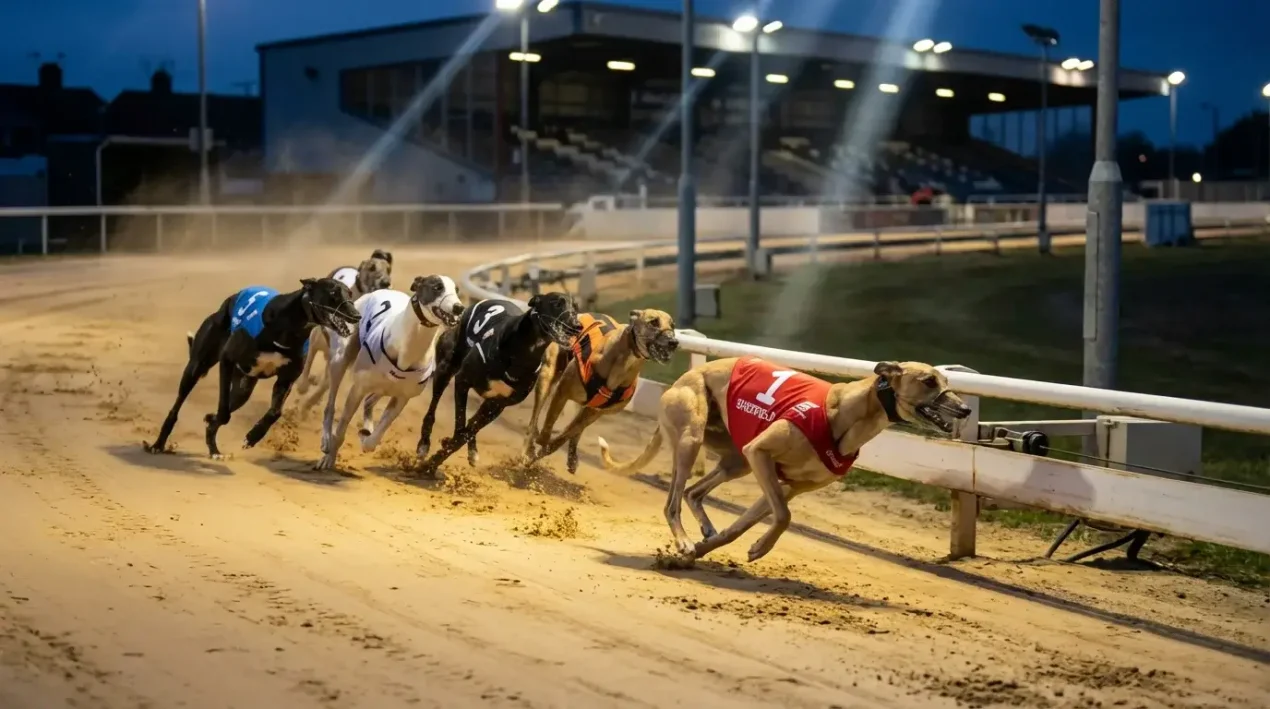
Contents
Greyhound racing has a dirty secret that is not actually secret at all. The dog that reaches the first bend in front wins far more often than probability alone would suggest. Across thousands of UK races, the first-bend leader converts its advantage into a win at rates that dwarf every other positional indicator. If you understand nothing else about the dynamics of a six-dog race around a tight oval, understand this: early speed matters, and at most UK tracks it matters more than anything. Get more race analysis at greyhoundbettingsystem.
This is not a subtle analytical point that requires spreadsheets and regression models. It is a blunt, structural feature of the sport, driven by the geometry of the tracks and the physics of six dogs trying to negotiate a bend at the same time. What it demands from punters is not complexity but attention — the willingness to identify fast breakers, assess the early pace dynamics of each race, and use that information when the market has not fully priced it in.
The First Bend Advantage in Numbers
The statistics are consistent enough to be treated as structural rather than incidental. At tight UK tracks like Romford, the dog leading at the first bend wins approximately 30 to 35 percent of races. In a six-runner field, a random distribution would give each dog roughly a 16.7 percent chance of winning, so the first-bend leader is winning at roughly twice the expected rate. At more galloping tracks like Nottingham, the advantage is smaller but still significant, typically around 25 to 28 percent.
The reason is mechanical. The first bend is where the race compresses. Six dogs running at nearly forty miles per hour converge on a space that can only comfortably fit two or three abreast. The dog that arrives first gets the clean run. It takes the bend without interference, maintains its speed, and emerges into the back straight with a lead that translates into both a physical and psychological advantage. The dogs behind are bumping, checking, losing momentum, and trying to find racing room that may not exist.
This is not a temporary phase. The interference at the first bend often defines the rest of the race. A dog that gets checked at the first bend loses not just the time of the check itself but the acceleration energy needed to regain its stride. At sprint distances of 400 metres or less, there simply is not enough track remaining to make up that lost ground against a clean-running leader. Over longer distances, the closing dog gets more time, which is why the first-bend advantage diminishes slightly as race distance increases, but it never disappears entirely.
Identifying Fast Breakers
The racecard gives you the tools to identify which dogs are likely to lead at the first bend. The most direct indicator is the positional data in the form lines. Look at the first number in each sequence — that is the dog’s position at the first bend in its previous races. A dog whose form reads 1-1-1, 1-2-1, 1-1-2 across its last three runs is a consistently fast breaker. One whose form shows 4-3-3, 5-4-4, 3-3-2 is not.
Sectional times offer a more precise measurement. The split from trap to first bend quantifies how quickly a dog breaks and reaches the turn. Comparing these early splits across the six runners in a race gives you a clear picture of which dogs will contest the early lead and which will be playing catch-up from the first bend onwards. When one dog’s early split is consistently two-tenths of a second faster than the rest of the field, that advantage is significant and measurable.
Trap draw interacts with early speed in a way that amplifies or negates the advantage. A fast breaker drawn in trap 1 has the shortest run to the first bend and the inside position — the combination is powerful. A fast breaker drawn in trap 6 still has the speed, but it must cover more ground to reach the bend and may not secure the lead despite being the fastest out of the boxes. The interaction between breaking speed and trap position is the first thing experienced punters assess when looking at a race.
Weight and age also play roles. Younger dogs in their first season often lack the trap experience to break consistently, even if their raw speed is there. Older, more experienced dogs tend to have more reliable trap behaviour. A slight recent weight drop sometimes coincides with sharper early speed, though this is a trend to observe rather than a rule to apply rigidly.
Where Early Pace Matters Most
The importance of early speed varies meaningfully across UK tracks, and knowing which venues place the highest premium on it is essential for adjusting your approach. Romford is the clearest example. The run from the traps to the first bend is short, the bend itself is tight, and the inside position is almost worth a length before the race has properly begun. At Romford over 400 metres, if you cannot identify the likely first-bend leader, you are betting blind.
Crayford has a slightly more generous run-up but the first bend is still critical. Central Park follows a similar pattern. At these tighter south-east circuits, early pace is not just an advantage — it is often the deciding factor in the race. Punters who specialise at these tracks learn to weight early speed analysis above almost every other form factor.
At galloping tracks like Nottingham, the first bend is still important, but the wider layout and longer straights give mid-race pace and closing speed more influence on the result. A strong finisher that sits third at the first bend has more time and space to overhaul the leader at Nottingham than it would at Romford. The first-bend leader still wins more often than any other dog, but the margin of advantage is narrower, and betting strategies can account for closing ability more meaningfully at these venues.
Distance plays a role too. Over sprint distances of 270 metres or less, the race is effectively decided in the first five seconds. Over marathon trips of 640 metres or more, early pace sets up the race but stamina determines the finish. The standard distances of 400 to 480 metres occupy the middle ground, where early pace provides an advantage but does not guarantee victory.
Building a Pace-Based Betting Strategy
A pace-based approach starts with a single question before every race: which dog is most likely to lead at the first bend? Answer that, and you have identified the statistically most likely winner. The question then becomes whether the market has already priced in that advantage or whether there is value to be found.
The simplest application is to focus on races where one dog has a clear early pace advantage over the rest of the field and is drawn in a low trap that complements its speed. When the fastest breaker is drawn trap 1 at a tight track and the market has it at a reasonable price, the structural advantages are stacked in your favour. These are the races where confidence should be highest.
More interesting situations arise when multiple dogs in the field have strong early pace. If three of six runners are fast breakers, the first bend becomes a congestion point. In these races, the value often shifts to the closer — the dog sitting fourth or fifth at the first bend who avoids the carnage and picks up the pieces in the closing straight. Identifying these congested pace scenarios and fading the obvious speed dog in favour of the patient closer is a more advanced application, but the logic is sound and the racecard gives you everything you need to make the assessment. Also explore our form analysis guide.
Early speed is not the whole story in greyhound racing. But it is the first chapter, and ignoring it puts you at a disadvantage against every punter who takes it seriously. The data is on the racecard. The patterns are in the sectional times. The edge is there for anyone willing to look.
