
Dutching Greyhounds: Step-by-Step Calculator Guide
 Available in US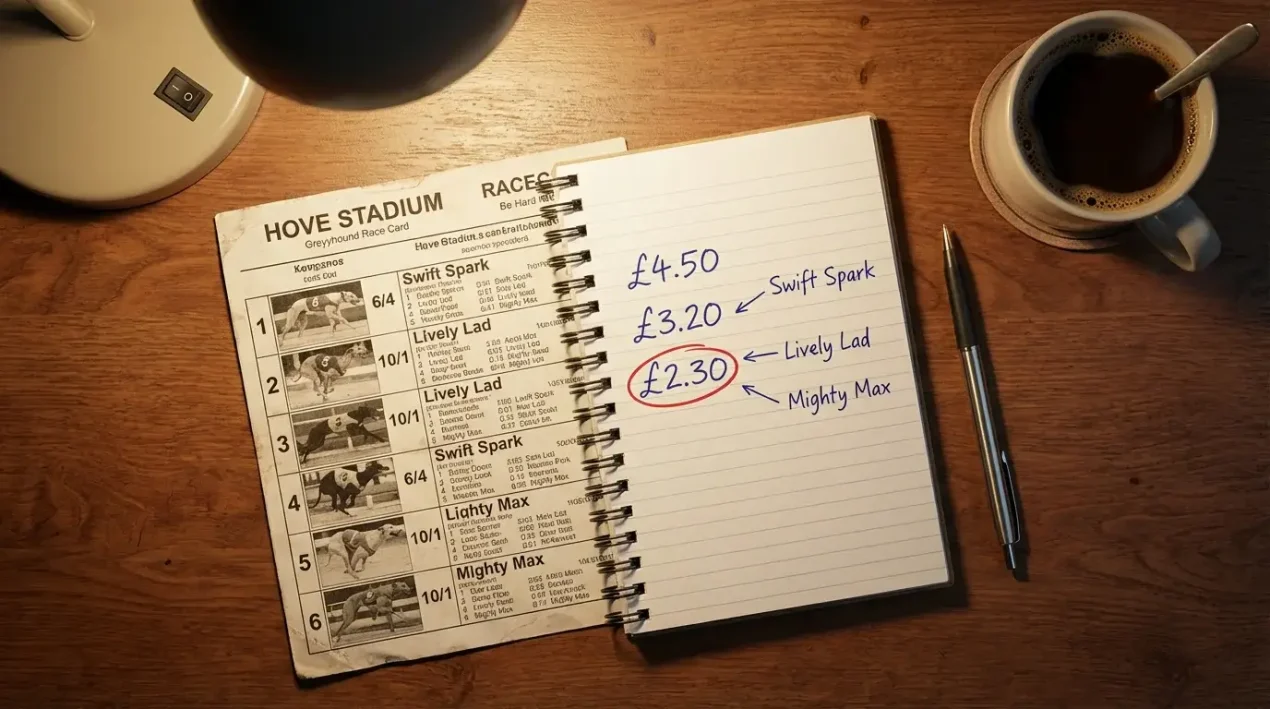
Contents
Most punters back one dog per race and hope for the best. Dutching takes a different approach entirely: you back two or more dogs in the same race, adjusting the stake on each so that you make the same profit regardless of which one wins. It sounds like a cheat code. It is not. But it is a legitimate, mathematically sound strategy that has been used in betting for nearly a century, and in the right circumstances it can turn a race where you fancy two or three dogs into a structured opportunity rather than a coin flip between them. Find more strategy guides at greyhoundbettingsystem.
The name comes from Arthur Flegenheimer, better known as Dutch Schultz, a Prohibition-era New York mobster. Schultz reportedly developed the method of proportional staking at horse racetracks in the 1920s and 1930s (Sporting Life). The system migrated to greyhounds where it arguably works better, because six-runner fields with tighter odds ranges create more natural dutching opportunities than sprawling horse racing handicaps. If you have ever looked at a greyhound race and thought “I like two of these but I cannot split them,” dutching is the answer to that problem.
What follows is a practical guide to how dutching works, how to calculate the stakes, when the approach makes sense, and where punters go wrong with it.
How Dutching Works
The core principle is straightforward. Instead of placing your entire stake on a single selection, you divide it across two or more dogs in proportions that produce an equal return regardless of which dog wins. The dog at shorter odds receives a larger stake. The dog at longer odds receives a smaller stake. The maths ensures that if any of your selections wins, the payout is the same.
Consider a simple example with two dogs. Dog A is priced at 3/1 and Dog B is priced at 5/1. You want to back both with a total outlay of ten pounds. If you simply split the stake evenly at five pounds each, Dog A winning returns twenty pounds while Dog B winning returns thirty pounds. That is not dutching — that is just backing two dogs with equal stakes and getting different returns.
Proper dutching adjusts the stakes so the return is identical. In this case, you would place a larger stake on Dog A (the shorter price) and a smaller stake on Dog B (the longer price). The exact amounts are calculated using a formula based on the implied probabilities of each selection, which we will work through shortly.
The beauty of dutching is that it converts uncertainty between multiple fancied runners into a single, binary outcome: either one of your selections wins and you profit, or none of them wins and you lose the combined stake. You have eliminated the frustrating scenario of backing one dog and watching another of your fancied runners win the race. That emotional benefit is real, but the mathematical benefit is what matters long-term.
Dutching works best when you genuinely believe that the winner will come from a subset of the field but cannot identify which specific dog it will be. In greyhound racing, this happens regularly. A six-dog race might feature two strong contenders with the rest of the field clearly outclassed. Rather than choosing between them and potentially picking wrong, dutching lets you back both and profit from either winning.
The catch — and there is always a catch — is that dutching only produces a profit when the combined implied probability of your selections is less than 100 percent. If you try to dutch three dogs whose odds imply a combined probability above 100 percent, you are guaranteed to lose money regardless of which one wins. The bookmaker’s overround works against you, and adding more selections typically makes this worse rather than better. Selectivity is essential.
Calculating Dutch Stakes Step by Step
The mathematics of dutching requires converting fractional odds to implied probabilities, summing those probabilities, and then distributing your total stake proportionally. It sounds involved, but the process becomes mechanical once you have done it a few times.
Step one: convert each selection’s odds to implied probability. For fractional odds, the formula is: Implied Probability = Denominator / (Numerator + Denominator). So 3/1 becomes 1 / (3+1) = 0.25, or 25 percent. And 5/1 becomes 1 / (5+1) = 0.1667, or 16.67 percent. For decimal odds, simply divide 1 by the decimal price.
Step two: sum the implied probabilities of your selections. In our example, 25% + 16.67% = 41.67%. This combined figure is called the dutch book percentage. If it is below 100 percent, the dutch is viable. The lower the combined percentage, the more profitable the dutch will be when a selection wins.
Step three: calculate each individual stake. The stake on each selection equals (Individual Implied Probability / Total Implied Probability) multiplied by your total outlay. For Dog A at 3/1 with a ten-pound total stake: (0.25 / 0.4167) x 10 = 6.00 pounds. For Dog B at 5/1: (0.1667 / 0.4167) x 10 = 4.00 pounds.
Step four: verify the returns. If Dog A wins at 3/1, the return is 6.00 x 4 = 24.00 pounds. If Dog B wins at 5/1, the return is 4.00 x 6 = 24.00 pounds. Both scenarios return 24 pounds from a 10-pound outlay, giving a profit of 14 pounds. The dutch is balanced.
In practice, most punters do not do this arithmetic by hand. Free dutching calculators are available online from services like Oddschecker and various betting tools. You enter the odds for each selection and your total stake, and the calculator distributes the stakes automatically. But understanding the underlying maths matters, because it tells you why certain dutches are profitable and others are not, and it prevents you from making errors that a calculator might obscure.
When to Dutch in Greyhound Racing
Dutching is not a universal strategy. It suits specific race profiles and falls apart in others. The ideal dutching scenario in greyhound racing is a competitive race where you have identified two or three dogs that are clearly superior to the rest of the field but are difficult to separate from each other. This happens most often in mid-grade races where the field contains a couple of decent performers alongside clearly weaker opposition.
Races with a dominant favourite are poor dutching candidates. If one dog is priced at 4/6 and the next best is 5/1, dutching both produces a thin margin because the short-priced favourite consumes most of your stake for a modest return. The value proposition only works when the selections are at genuine odds — typically 2/1 or longer for at least two of the dogs in the dutch.
Open races can offer strong dutching opportunities because the form from different tracks is harder to compare, creating genuine uncertainty about which of the leading contenders will prevail. When two open-race dogs from different tracks both have strong credentials but neither has a decisive form advantage, backing both through a dutch is a rational response to genuine uncertainty rather than an admission of poor analysis.
BAGS afternoon meetings occasionally produce dutching opportunities when a graded race features two or three dogs whose recent form is clearly superior to the rest of the field but whose relative merits are hard to judge. The lower public interest in these meetings can mean that odds remain more generous than for evening cards, improving the dutching margin.
Avoid dutching in races where the entire field is closely matched. If all six dogs have a realistic chance, you would need to dutch so many selections that the combined implied probability exceeds 100 percent and the bet becomes mathematically unviable. Dutching works through selectivity. Three dogs maximum is a sensible ceiling for most greyhound dutches, and two is often optimal.
Common Dutching Mistakes
The most frequent error is dutching too many selections. Every additional dog you add to the dutch increases the combined implied probability and shrinks your potential profit. A two-dog dutch at combined odds of 40 percent leaves plenty of room for profit. A four-dog dutch at combined odds of 75 percent barely covers the overround. The temptation to include a third or fourth dog “just in case” is understandable but mathematically costly.
Another common mistake is ignoring the overround. Bookmaker odds include a built-in margin, which means the implied probabilities across all six dogs in a race sum to more than 100 percent. This overround eats into your dutching profit. If the overround is high, even a well-selected dutch can produce a marginal return that does not justify the effort. Checking the total overround before committing to a dutch is a basic discipline that many punters skip.
Failing to lock in prices is a practical error that undermines the maths. Dutching calculations are based on specific odds at the moment you place the bets. If you back one dog and then the other dog’s price shortens before you place the second bet, the dutch is no longer balanced. Place all legs of the dutch simultaneously, or use a bookmaker that allows multiple selections in the same race with guaranteed prices.
Finally, some punters dutch habitually rather than selectively. Not every race is a dutching race. If you cannot identify a clear subset of the field that is likely to produce the winner, the dutch becomes an expensive way to cover uncertainty rather than a strategic tool. The discipline of saying “this race is not suitable for dutching” is as important as the ability to calculate the stakes when the conditions are right. Also explore our betting systems guide.
Dutching is a tool, not a system. It does not remove the need for sound selection. It does not guarantee profit over time. What it does is convert a specific type of uncertainty — “I like two dogs but cannot split them” — into a structured bet with a defined risk and a consistent return. Used selectively, in races that suit the approach, it is one of the most practical techniques available to greyhound punters. Used indiscriminately, it is an efficient way to donate money to the bookmaker’s margin.
