
Greyhound Accumulators: Building Multi-Race Bets
Best Greyhound Betting Sites – Bet on Greyhounds in 2026
Loading...
Contents
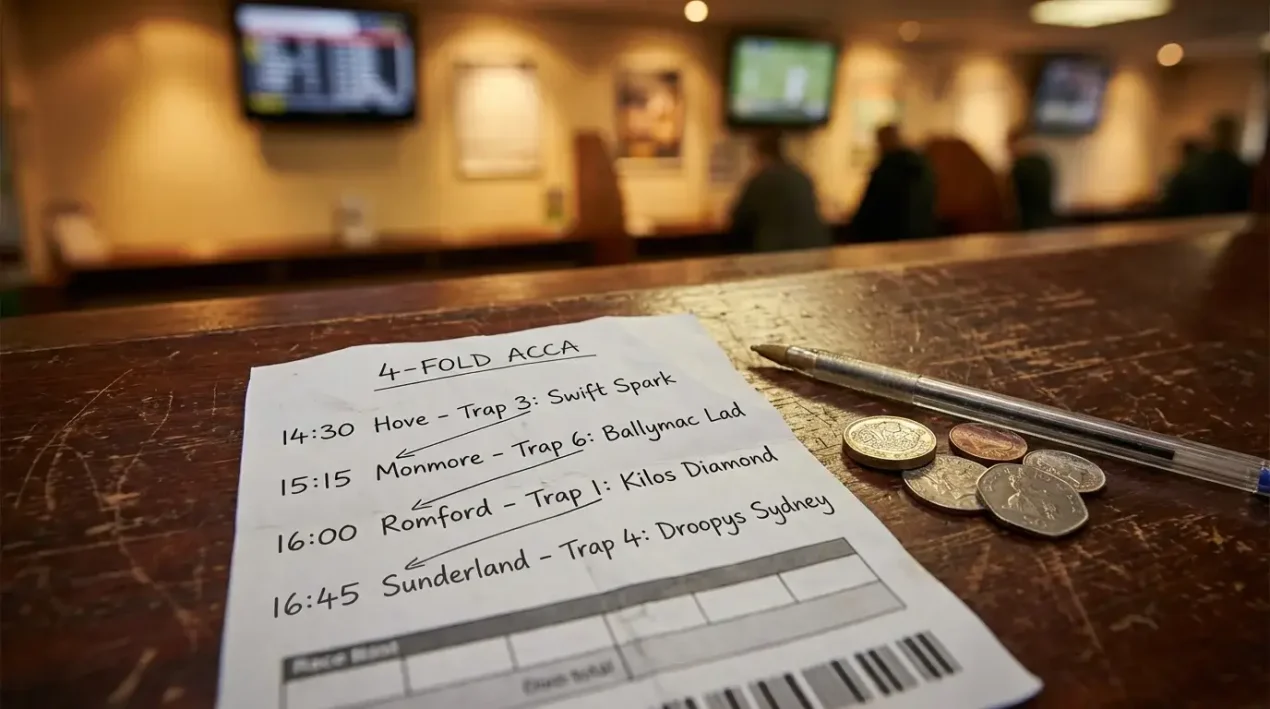
Accumulators are the fireworks of greyhound betting. A small stake, three or four or five selections linked together, and the promise of a return that makes single bets look timid by comparison. A ten-pound four-fold at average odds can return several hundred pounds. A six-fold can push into four figures. The appeal is visceral and immediate, which is exactly why bookmakers promote them so enthusiastically and exactly why punters should approach them with caution.
The mathematics of accumulators are not complicated, but they are unforgiving. Every selection you add multiplies the difficulty, and the probability of landing all legs drops faster than most punters realise. Understanding how accumulators work, why bookmakers love them, and how to build them sensibly — if you choose to build them at all — is essential knowledge for anyone who bets on greyhounds regularly.
Building a Greyhound Accumulator
An accumulator links two or more selections from different races into a single bet. The winnings from the first selection roll onto the second, the combined winnings roll onto the third, and so on through every leg. All selections must win for the bet to pay out. One loser anywhere in the chain and the entire accumulator loses, regardless of how many other legs won.
A double links two selections. A treble links three. Beyond that, accumulators are named by the number of legs: four-fold, five-fold, six-fold. There is no theoretical upper limit, but practical limits apply because each additional leg makes the bet exponentially harder to land.
The return calculation is straightforward: multiply the decimal odds of each selection together, then multiply by your stake. If you back three dogs at 3.0, 2.5, and 4.0 in a treble with a five-pound stake, the potential return is 3.0 x 2.5 x 4.0 x 5 = 150 pounds. That 150-pound return from a five-pound stake is the seduction. The probability of actually landing it is the sobering counterbalance.
Selection order does not matter in an accumulator — the bets are linked but independent. What matters is that every selection must win its individual race. This creates a fundamentally different risk profile from single betting. With singles, a losing bet costs one stake. With accumulators, a losing bet costs the entire potential chain of returns, and the emotional investment in an accumulator that falls at the last leg is substantially higher than the financial investment in the stake.
When building a greyhound accumulator, the most important discipline is treating each leg as an independent selection that you would back as a single. If a dog is not strong enough to warrant a standalone bet, it should not be included in an accumulator. Adding weaker selections to pad out a four-fold because you need more legs is one of the most common mistakes in accumulator betting, and it transforms a reasonable multi-race bet into a barely-considered gamble.
Why Bookmakers Love Accumulators
Bookmakers promote accumulators aggressively for a simple reason: they are enormously profitable for the operator. Every additional leg in an accumulator compounds the bookmaker’s margin. On a single bet, the overround might give the bookmaker a 10 to 15 percent edge. On a four-fold, that edge is compounded four times, producing a cumulative margin that can exceed 40 percent. The punter is paying the bookmaker’s margin on every leg simultaneously.
The mathematics are stark. Suppose each selection has a true win probability of 33 percent (a typical greyhound favourite) but is priced at 2/1, which implies a 33.3 percent chance. On a single, the margin is negligible. On a four-fold, the probability of all four winning is 0.33^4 = approximately 1.2 percent, but the implied probability from the combined odds is slightly lower after the compounded margins are factored in. Over thousands of accumulators placed by thousands of punters, the bookmaker retains a larger slice of the total wagered than on any other bet type.
Acca insurance and bonus promotions exist because the bookmaker can afford to give back a small percentage of the margin while still retaining a healthy profit. A “money back if one leg loses” offer sounds generous, but the bookmaker has already priced the expected cost of that concession into its overall accumulator margin. These promotions make accumulators feel safer without materially changing the long-term economics.
None of this means accumulators are inherently wrong. It means they should be used with full awareness of the built-in cost. Betting a ten-pound four-fold is not ten pounds of risk at the same house edge as a ten-pound single. It is ten pounds of risk at a substantially higher effective margin, and the expected return per pound staked is lower than on singles or doubles.
Building Sensible Accumulators
If you are going to bet accumulators — and many punters enjoy them regardless of the mathematics — building them sensibly minimises the structural disadvantage. The first principle is to keep the number of legs low. Doubles and trebles offer the compound returns of multi-race betting without the extreme probability reduction of longer accumulators. A well-chosen treble at average odds of 3/1 per leg can still return over 60 to 1, which satisfies the desire for a big payout without requiring four, five, or six independent events to all go right.
Selection quality matters more in accumulators than in singles. Each leg is a potential failure point, and the weakest leg determines the strength of the entire chain. If three of your four selections are solid 70 percent confidence picks and the fourth is a speculative 40 percent shot, the overall probability drops to roughly 0.7 x 0.7 x 0.7 x 0.4 = 13.7 percent. Remove the speculative leg and the treble has a 34.3 percent chance. That one weak selection halved the probability of the entire bet landing.
Consider restricting accumulators to races at tracks you know well. Form assessment is sharper when you understand the specific track dynamics, and the selections are stronger as a result. A treble across three races at your specialist track is a better proposition than a four-fold spanning four tracks you follow casually.
Staking should reflect the recreational nature of most accumulator betting. The standard advice is to allocate a small, fixed percentage of your betting bank to accumulators and treat them as a bonus rather than a core strategy. If your regular staking is two percent of bank per single, accumulator stakes might be 0.5 percent or less. This ensures that the inevitable losing streaks do not erode the bank that supports your more disciplined single betting.
Cover Bets: Trixies, Patents, and Yankees
Cover bets are structured multiples that provide insurance against one or more losers in a multi-selection bet. They cost more than a straight accumulator but pay out in more scenarios, reducing the all-or-nothing nature of standard accumulators.
A Trixie covers three selections in four bets: three doubles and one treble. If all three win, you collect on all four bets. If two of three win, you still collect on one double. The cost is four times your unit stake, but the safety net of the doubles means a single losing leg does not wipe out the entire bet. For greyhound punters who want multi-race action without the brutality of a straight treble, the Trixie is a practical compromise.
A Patent extends the Trixie by adding three singles to the mix: three singles, three doubles, and one treble, totalling seven bets. The Patent pays out if even one of your three selections wins, making it the most defensive of the common cover bets. The cost is seven times your unit stake, which is substantial, but the return profile is more forgiving. A Patent is suited to selections at longer odds where even a single winner at 5/1 or above can return a profit on the total outlay.
A Yankee covers four selections in eleven bets: six doubles, four trebles, and one four-fold. It costs eleven units and requires at least two winners to generate a return. The Yankee is popular for Saturday evening cards where a punter has strong views on four races and wants broader coverage than a straight four-fold allows.
The trade-off with cover bets is always cost versus coverage. A Trixie costs four times what a straight treble costs, and the return when all three win is the same total of all component bets, which is less per unit staked than the treble alone. You are paying for insurance, and insurance always has a premium. Whether that premium is worth paying depends on your risk tolerance and the odds of your selections.
Accumulators are part of greyhound betting culture, and they are not going away. The thrill of watching a four-fold come together race by race is genuine, and no amount of mathematical analysis eliminates that appeal. But building them with discipline, keeping them short, selecting each leg on its own merits, and understanding the compounded margin you are paying to the bookmaker turns what could be a mindless punt into a considered bet. The bookmaker wants you to build long, loose accumulators. Building short, tight ones is how you push back.