
Greyhound Forecast Bets: Straight and Reverse Explained
Best Greyhound Betting Sites – Bet on Greyhounds in 2026
Loading...
Contents
A forecast bet asks you to predict which two dogs will finish first and second in a race. It is a step up in difficulty from a simple win bet, because you need to identify not just the winner but the runner-up as well. The payoff for that additional difficulty is substantially higher returns. Where a win bet on a 4/1 shot returns five times your stake, a forecast involving the same dog can return ten, twenty, or even fifty times your stake depending on the combination. That potential is what draws punters to forecasts, and understanding the different types — straight, reverse, and combination — is essential before you start placing them.
Forecast betting suits punters who are willing to trade strike rate for return. You will win fewer bets than with simple win selections, but the winners you do find pay significantly more. Whether that trade-off is worthwhile depends on the quality of your analysis and your ability to identify not just the likely winner but the probable shape of the entire race.
Straight Forecast: Exact Order
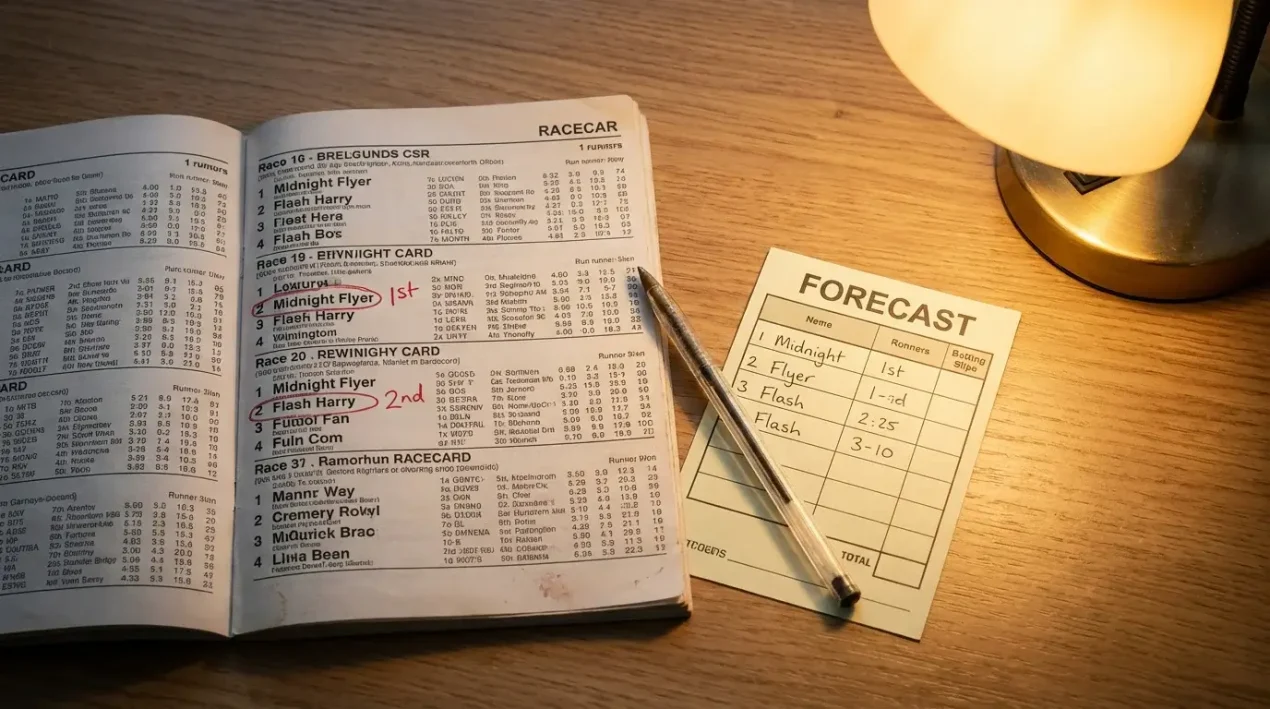
A straight forecast is the purest form: you nominate one dog to finish first and another to finish second, in that exact order. If Dog A wins and Dog B finishes second, you collect. If Dog B wins and Dog A finishes second, you lose. The order matters, and that precision is what makes straight forecasts both difficult and rewarding.
The payout on a straight forecast is calculated by the bookmaker or tote after the race, based on the actual finishing odds of both dogs. There is no fixed price available when you place the bet — the return depends on the starting prices of the two selections and the forecast dividend declared for that specific combination. This means you do not know your exact potential return when you place the bet, which is a different dynamic from taking a fixed-odds win bet.
Straight forecasts require genuine conviction about the finishing order. You need a view not just on which two dogs are the best in the race, but on which of the two is more likely to beat the other. This means analysing the early pace of both selections, their running styles, their likely positions through the race, and how they interact with the rest of the field. A fast breaker drawn inside might be a confident first pick, with a strong closer drawn wider as the second pick — the expected race narrative being that the inside dog leads and the closer runs on into second.
The value in straight forecasts comes from correctly predicting an order that the general public does not anticipate. When the obvious favourite finishes first and the second favourite finishes second, the forecast dividend is modest because many punters backed that combination. When a less obvious pairing fills the first two places, the dividend can be substantial because fewer bets covered that specific outcome.
Reverse Forecast: Either Order
A reverse forecast covers both possible finishing orders of your two selected dogs. If you back Dog A and Dog B in a reverse forecast, you win if either Dog A finishes first with Dog B second, or Dog B finishes first with Dog A second. It is effectively two straight forecasts combined into one bet, which means it costs twice the stake of a straight forecast.
The reverse forecast is the natural choice when you are confident that two dogs will fill the first two places but cannot determine which will beat the other. This situation arises frequently in greyhound racing, particularly when two dogs have similar ability but different running styles that make their head-to-head outcome hard to predict. A fast breaker and a strong closer might both be clearly superior to the rest of the field, but which one prevails depends on how the race unfolds in real time.
The return on a reverse forecast depends on which combination wins. If Dog A beats Dog B, you receive the straight forecast dividend for that order. If Dog B beats Dog A, you receive the dividend for the other order. These two dividends are often different because the starting prices of the two dogs are different, and the forecast calculation produces different returns depending on which dog is first and which is second.
The cost-benefit calculation for reverse versus straight forecasts is simple. If you genuinely believe one dog will beat the other, a straight forecast at half the cost gives you the same return. If you cannot split them, the reverse forecast costs double but ensures you do not back the wrong order. The decision should be based on your analytical confidence, not on a blanket preference for one type over the other.
Combination Forecasts: Three or More Dogs
A combination forecast extends the reverse forecast principle to three or more dogs. You select multiple dogs and the bet covers every possible first-second combination among them. The more dogs you include, the more combinations the bet covers, and the more it costs.
With three dogs, a combination forecast covers six permutations: A first B second, A first C second, B first A second, B first C second, C first A second, and C first B second. Each permutation is a separate straight forecast bet, so a one-pound combination forecast with three dogs costs six pounds. With four dogs, the permutations rise to twelve, and the cost rises accordingly. Five dogs produce twenty permutations, and so on.
The appeal of combination forecasts is coverage. If you believe the winner will come from three dogs but you cannot predict the exact order, the combination forecast ensures you are on the right side regardless of which two fill the places and in what order. The trade-off is cost: six pounds for the same return you would get from a one-pound straight forecast if you got the exact order right.
Combination forecasts make most sense when the dogs in your selection pool are at mid-range to longer odds. If all three dogs are priced between 3/1 and 6/1, the forecast dividends tend to be generous enough to absorb the cost of covering multiple permutations. If one of the dogs is a heavy favourite, the forecast dividend for combinations involving that dog tends to be compressed, and the combination forecast may not return enough to justify the outlay.
The discipline with combination forecasts is resisting the temptation to include too many dogs. Four-dog combinations cost twelve units. Five-dog combinations cost twenty. At some point, you are covering so many permutations that the cost erodes the value of any likely dividend. Three dogs is the practical ceiling for most greyhound combination forecasts, and even that should be reserved for races where your analysis clearly identifies three runners that stand out from the field.
Calculating Forecast Stakes and Returns
Forecast stakes are calculated by multiplying the number of permutations by your unit stake. The permutation count follows a simple formula: for n selected dogs, the number of forecast permutations is n multiplied by (n-1). Two dogs give 2 permutations (reverse forecast). Three dogs give 6. Four dogs give 12. Five dogs give 20.
Returns are declared after the race as a dividend per one-pound unit. The Computer Straight Forecast, or CSF, is the industry standard calculation used by most bookmakers and the tote. It is based on the starting prices of the first two finishers and produces a dividend that reflects how difficult the result was to predict. A forecast involving two short-priced dogs produces a smaller dividend. A forecast involving an outsider produces a larger one.
Before placing any forecast bet, calculate the total cost and assess whether the likely dividend justifies it. If you are covering a three-dog combination forecast at two pounds per permutation, the total cost is twelve pounds. You need the winning combination to return more than twelve pounds to make a profit. Estimating the likely dividend based on the dogs’ current odds gives you a rough guide — if all three dogs are 5/1 or longer, the forecast dividend is likely to be substantial. If one is the 6/4 favourite, the dividend may be disappointing relative to the cost.
Forecast betting in greyhound racing rewards punters who can read the shape of a race beyond just the winner. Identifying the likely first two finishers requires understanding pace, running styles, trap draws, and how the field will interact through the bends. It is more demanding than win betting, and the strike rate is lower. But the returns, when you get it right, reflect that difficulty. Approach forecasts as a selective addition to your betting rather than a routine activity, and they add a dimension that simple win betting cannot match.