How to Read Greyhound Form Cards: Complete Breakdown
Best Greyhound Betting Sites – Bet on Greyhounds in 2026
Loading...
Contents
A greyhound racecard is a compressed biography. Every number, letter, and abbreviation tells you something about what a dog has done, how it has done it, and what conditions surrounded the performance. The problem for newcomers is that the compression is extreme. A single form line packs in the date, track, distance, trap, position at various stages, finishing position, time, weight, grade, and a comment — all in a space smaller than a tweet.
Learning to read these cards fluently is not a luxury for serious punters. It is the minimum requirement. The racecard is the primary document from which all form analysis begins, and every piece of information it contains exists because it has proven useful for assessing what a dog might do next. Skip the racecard and you are guessing. Read it properly and you have the raw material for informed decisions.
The Layout of a Greyhound Racecard
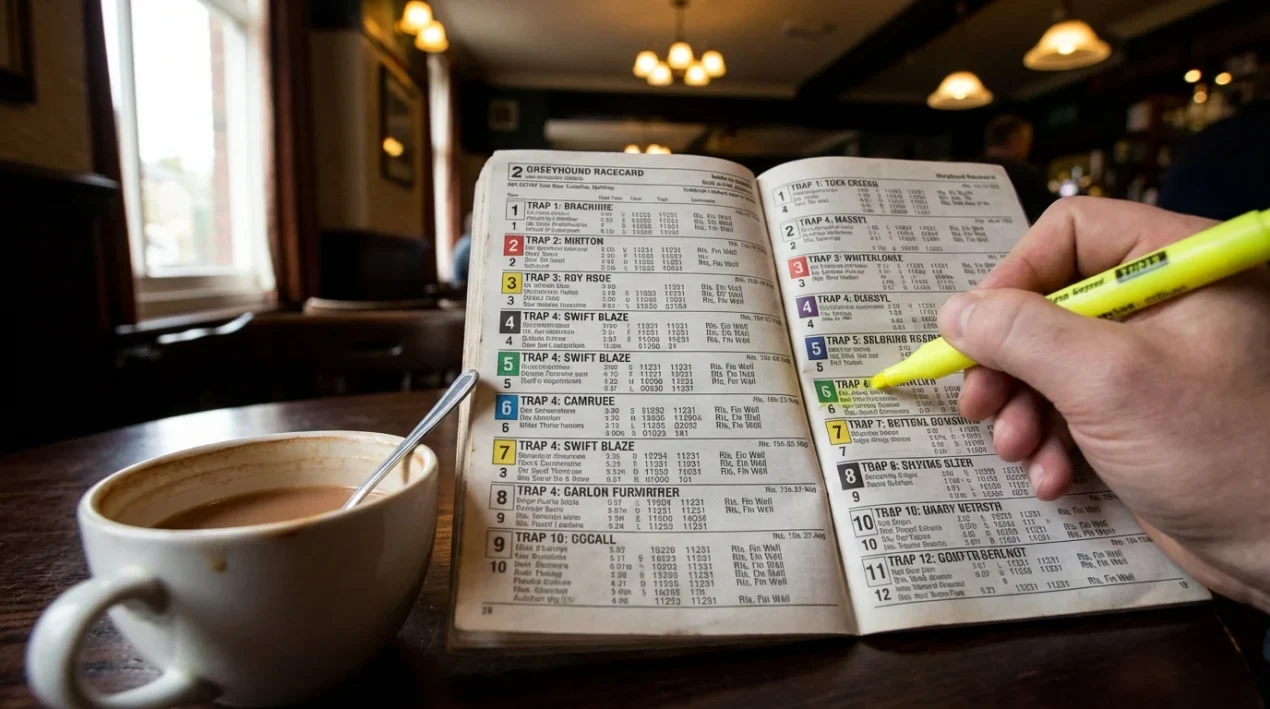
A standard UK greyhound racecard lists the six runners in trap order, one through six. For each dog, you will see its name, trap number and colour, age, sex, colour, sire and dam, trainer, and owner. Below the identification details sits the form, typically the last six runs displayed in reverse chronological order with the most recent run first.
Each form line reads from left to right and includes the date of the race, the track where it took place, the distance, the trap number drawn, and then a sequence of positional numbers. These positional numbers show where the dog sat at key stages of the race: typically the position at the first bend, the position at subsequent bends (for longer trips), and the finishing position. A line reading “1-1-1” means the dog led from the first bend all the way to the line. A line reading “5-3-2” means it was fifth at the first bend, improved to third by the second bend, and finished second. These positional progressions are enormously informative because they reveal the dog’s running pattern, not just its result.
After the positional data comes the finishing time, the winning margin or the distance beaten, the weight of the dog at that meeting, and the race grade. Finally, there is a short comment describing key in-running events. These comments are written in abbreviated shorthand by the race stewards, and decoding them is a skill in itself.
The weight and date information might seem minor, but weight fluctuations across recent runs can signal training changes, health issues, or peak condition. A dog that has gained a kilogram between runs might have been freshened up with rest. One that has lost weight consistently over several outings might be racing too frequently or not thriving.
Decoding Form Abbreviations
The comments section of a form line uses a standardised set of abbreviations that every regular punter needs to know. “Led” or “Ld” means the dog led at that point in the race. “Bmp” means it was bumped, “Ck” means it was checked or impeded, and “SAw” means slow away from the traps. “Crd” indicates crowding, where multiple dogs converged on the same space.
Running style abbreviations appear elsewhere on the card. “R” denotes a railer, a dog that naturally seeks the inside rail. “M” marks a middle runner, and “W” identifies a wide runner (Timeform — How to Read a Racecard). These single letters carry significant weight because they tell you how the dog prefers to run, which in turn determines how well suited it is to its drawn trap.
Track abbreviations identify the venue: “Rom” for Romford, “Not” for Nottingham, “Crd” for Crayford, “Mon” for Monmore, and so on. When a dog’s recent form spans multiple tracks, these abbreviations help you understand the variety of conditions it has faced. A dog whose last four runs are all at the same track is a different evaluation from one that has been shuttled between three venues.
Grade indicators appear as part of each form line and show the level of competition the dog was facing. Seeing that a dog finished third in an A2 race tells a very different story from a third-place finish in A6. The grade context transforms a raw finishing position into meaningful information about ability and competitiveness.
Interpreting Form in Practice
Reading the individual elements is one thing. Synthesising them into a judgment about a dog’s likely performance is where the real skill lies. The best approach is to read form lines as stories rather than isolated data points. A dog whose last three lines show 6-5-4, 4-3-2, and 3-2-1 is a dog in visibly improving form, gradually getting to the front more quickly. The trend matters more than any single run.
Look for patterns in the comments. If a dog has been bumped or checked in multiple recent runs, it may have had legitimate excuses for poor finishing positions. A form line that shows a fifth-place finish with “Bmp&Ck 1” (bumped and checked at the first bend) is far more forgiving than a clean run that still ended fifth. The context behind the number is where value hides.
Trap draws across recent form are also revealing. A dog that has been finishing third or fourth from trap 6 but is now drawn trap 2 might have been at a consistent positional disadvantage that is about to be removed. Conversely, a dog with strong recent form from trap 1 that is now drawn trap 5 might face trouble it has not recently encountered. The racecard gives you all of this information, but only if you look at the trap column across runs, not just the most recent one.
Time comparisons require care. A 29.50 at Romford over 400 metres is not directly comparable to a 29.50 at Nottingham over 480 metres — different tracks, different distances, different conditions. But comparing times at the same track and distance across a dog’s recent form does reveal whether it is getting faster, maintaining pace, or slowing down. That trajectory tells you more than any single time figure in isolation.
Common Mistakes When Reading Form
The most frequent error among beginners is looking only at finishing positions without reading the comments. A dog that finished sixth in its last start looks terrible on the surface. But if the comment reads “Led to 3, Ck&Fell” — meaning it led until the third bend before being checked and falling — the result tells you almost nothing about the dog’s ability. That dog might be the fastest in the race next time out.
Another common mistake is ignoring the grade column. Winning at A6 is not the same as winning at A3. A dog with three wins in its form that are all at lower grades might be about to face a significant step up. Without checking the grades, that dog looks like it is flying. With the grade context, you realise it has never been tested at this level.
Recency bias is the third trap. Punters overweight the most recent run and underweight the broader pattern. One bad run does not make a bad dog, and one brilliant run does not make a champion. The racecard gives you six runs precisely so you can assess the pattern rather than reacting to a single data point. Use all six.
The racecard is dense, compact, and initially overwhelming. But every element exists for a reason, and once you can read it fluently, you will never look at a greyhound race the same way. The form card does not tell you who will win. It tells you enough to form a view that is better than a guess, and in betting, that difference is everything.