
UK Greyhound Racing Basics: A Beginner’s Complete Guide
Best Greyhound Betting Sites – Bet on Greyhounds in 2026
Loading...
Contents
Greyhound racing has been part of British sporting life since the first modern meeting at Belle Vue, Manchester, on 24 July 1926 (GBGB centenary feature, SIS Racing). Nearly a century later, the sport still draws crowds to stadiums across England, with millions more watching through bookmaker live streams and placing bets on afternoon and evening cards. It remains one of the most accessible forms of professional racing in the country, yet many punters who bet on the dogs regularly have only a surface-level understanding of how it all fits together.
That gap between casual familiarity and genuine knowledge is where poor bets get made. Understanding the mechanics of a greyhound race, the types of competitions, the governance structure, and even the colour of the jackets is not trivial detail. These are the building blocks that every meaningful betting decision rests on. Whether you are placing your first bet or finally deciding to take it seriously, starting with the fundamentals is not just sensible. It is essential.
This guide covers everything a newcomer needs to know about UK greyhound racing before thinking about strategy, systems, or staking plans. Consider it the groundwork. The clever stuff comes later, but without this foundation it does not hold up.
How a Greyhound Race Actually Works
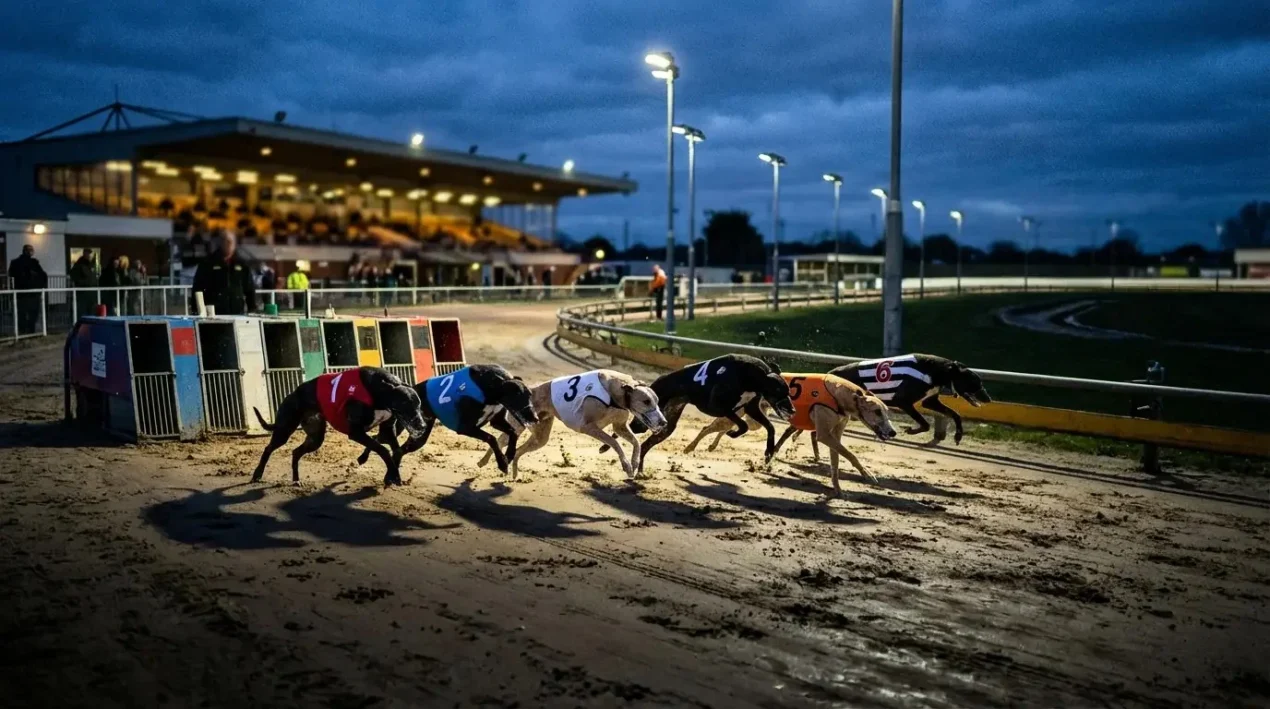
A standard UK greyhound race features six dogs competing on an oval sand track. Each dog is loaded into an individual starting trap, numbered one through six, with trap one positioned closest to the inside rail. When the mechanical hare passes the traps at speed, the lids spring open simultaneously and the dogs give chase.
The hare itself is an artificial lure mounted on a rail that runs along the inside or outside of the track, depending on the venue. It stays a fixed distance ahead of the leading dog, controlled by an experienced hare driver whose job is to keep it close enough to maintain the chase but far enough to avoid being caught. The pace of the hare can subtly influence how a race unfolds, and seasoned punters pay attention to which driver is on duty.
Most UK tracks are roughly oval with two bends, though configurations vary. Romford is notoriously tight with sharp bends, while Nottingham offers a more galloping layout with sweeping turns. These differences matter because they change which dogs thrive at which venues. A powerful wide runner can dominate at Nottingham but get squeezed out at Romford, where early pace and rail position count for far more.
Standard race distances in the UK range from around 210 metres (sprint races) up to 900 metres or more for marathon events, though the most common distances sit between 400 and 500 metres. Each track has its own set distances dictated by trap positions and bend placements. At most venues, you will see four or five different distances on a single racecard, adding variety to the form analysis required.
Races are graded to ensure competitive balance. Dogs of similar ability are grouped together, and their performance determines whether they move up or down through the grading system. This is not horse racing, where handicaps level the field through weight. In greyhound racing, grading does the heavy lifting, and understanding that structure is a prerequisite for making sense of form.
After the race, results are confirmed by a photo-finish camera if the margin is tight, and the judge’s decision is final. Times are recorded electronically, giving punters a precise metric to compare dogs across different meetings and tracks.
Types of Greyhound Races
Not every greyhound race is the same, and the type of event shapes the betting landscape significantly. The most common races on any card are graded events, where dogs of similar ability compete against each other. These are the bread and butter of UK greyhound racing and typically make up the majority of any evening or afternoon meeting.
Open races sit above the grading system entirely. These are the prestige events, attracting the best dogs in the country regardless of their home track. Open races are categorised from Category 1 at the top, which includes events like the English Greyhound Derby (currently held at Towcester), down through Category 2 and Category 3 (GBGB 2026 Category schedule). The quality of competition in these races is noticeably higher, and the form analysis required is more demanding because the dogs come from different tracks with different conditions. For punters, open races present both opportunity and complexity in roughly equal measure.
Puppy races are restricted to younger dogs, typically under two years old. These events are fascinating for punters willing to do the legwork, because young dogs improve rapidly and early form can be misleading. A puppy that finishes mid-pack in its first two runs might be a different animal by its fifth, having learned to break cleanly and navigate the bends. Spotting that improvement trajectory early is one of the genuine edges available in greyhound betting.
Hurdle races deserve a mention even though they represent a smaller portion of the calendar. Dogs jump four low hurdles during the race, and the skillset required is different from flat racing. Some dogs take to hurdling naturally while others lose ground at each obstacle. Hurdle racing has its own dedicated followers, and the specialist nature of the form means that casual punters often leave value on the table.
Marathon races, typically over 700 metres or more, test stamina rather than raw speed. The form dynamics change because early pace matters less and the ability to sustain effort through the final straight becomes decisive. These longer trips tend to produce more predictable results at the front of the market, which has implications for how you approach the betting.
Trap Colours and Draw Positions
Every greyhound wears a coloured racing jacket that corresponds to its trap number. This is not decorative. It is the primary way spectators and television viewers identify which dog is which during a race that lasts under thirty seconds at sprint distances. The colour system is standardised across all GBGB-licensed tracks in the UK.
Trap 1 is red, closest to the inside rail. Trap 2 is blue, trap 3 is white, trap 4 is black, trap 5 is orange, and trap 6 is black and white striped, positioned on the outside (GBGB Rules of Racing, Rule 118). If you watch enough racing, these associations become instinctive, but beginners often struggle in the first few meetings to track individual dogs through a pack of six moving at forty miles per hour.
The trap draw is not random. A Racing Manager at each track allocates traps based on each dog’s running style and recent form, attempting to create competitive and fair races. A dog that naturally runs along the rail, known as a railer, will ideally be drawn in traps 1 or 2. A wide runner, one that drifts towards the outside of the track, suits traps 5 or 6. When a dog’s running style conflicts with its trap draw, the race becomes harder for that dog, and that mismatch is precisely the kind of information that sharpens a betting decision.
The trap colours and positions might seem like minor detail, but they are your first piece of visual information when assessing a race. Knowing instantly that the red jacket is on the rail and the striped jacket is widest out lets you read a race in real time and understand why things unfolded as they did. That understanding feeds directly into smarter selections next time around.
Who Governs UK Greyhound Racing
The Greyhound Board of Great Britain, known as GBGB, is the regulatory body responsible for licensed greyhound racing in the UK. It oversees everything from track licensing and race grading to the welfare of the dogs and the integrity of the sport. If a track holds a GBGB licence, the races run under the official Rules of Racing, which cover drug testing, identification checks, grading procedures, and standards of care.
GBGB currently licenses around 20 tracks across England and Wales (the exact number fluctuates as venues open and close; the GBGB reported 21 licensed tracks in its 2024 data), and these are the venues where regulated, form-backed greyhound racing takes place. There is a separate, smaller circuit of independent or flapping tracks that operate outside GBGB governance. These unlicensed meetings do not have the same regulatory oversight, the form data is less reliable, and for betting purposes they are a different proposition entirely. Most serious punters stick to GBGB-licensed racing for good reason.
The regulatory framework matters to punters beyond abstract notions of fair play. GBGB licensing means that race times are officially recorded and published, form data is standardised across tracks, and there are procedures in place if something looks wrong. When you are using sectional times, trainer statistics, or grading moves to inform your betting, you are relying on data that exists because a licensing body mandates its collection. Without that infrastructure, greyhound betting would be considerably more speculative than it already is.
The UK Gambling Commission sits above the sport-specific bodies and regulates the betting side of things. All licensed bookmakers offering greyhound markets operate under UKGC oversight, which covers everything from odds fairness to responsible gambling provisions. The interaction between sport regulation and betting regulation creates the framework within which the entire greyhound betting ecosystem operates.
Greyhound racing rewards attention. The sport moves fast, the cards are frequent, and the amount of data available for each race is surprisingly rich once you know where to look. But that richness only becomes useful when you understand the underlying structure: how races are run, how dogs are graded, how traps are assigned, and who makes sure the whole thing operates fairly.
None of what you have read here will, on its own, produce a winning bet. That is not the point. The point is that every strategy, every system, every edge that experienced greyhound punters talk about is built on top of these basics. Skip them and you are building on sand. Learn them properly, and everything that follows will make considerably more sense.
The dogs are fast. The betting, done well, should be slow and deliberate. Start here, and work up.