Greyhound Running Styles: Railers, Wides and Middle Runners
Best Greyhound Betting Sites – Bet on Greyhounds in 2026
Loading...
Contents
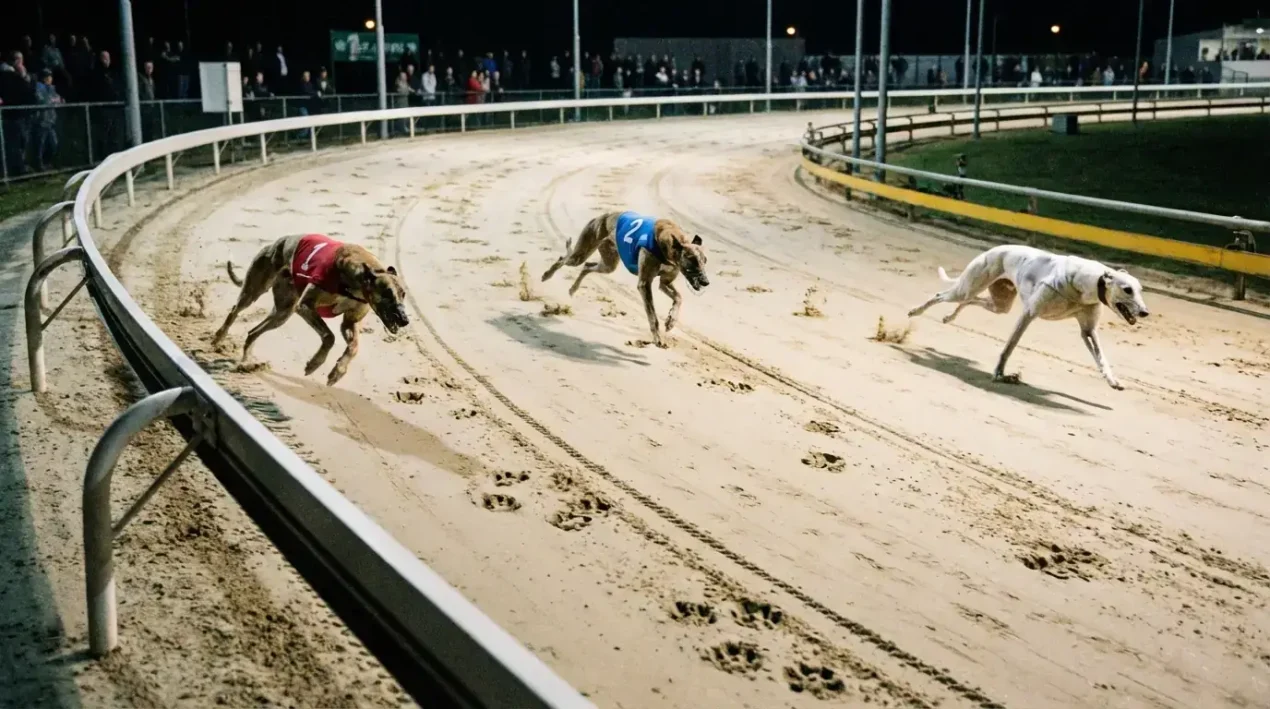
Every greyhound has a natural preference for where it runs on the track. Some hug the inside rail as though magnetised to it. Others drift wide through the bends, covering more ground but avoiding traffic. A third group sits between those extremes, neither committed to the rail nor naturally drawn outward. These tendencies are not random quirks — they are ingrained running styles that shape how a dog races and, crucially, how it interacts with the trap draw.
Understanding running styles is one of the simplest yet most overlooked analytical tools available to greyhound punters. A talented dog drawn in the wrong trap for its running style is a talented dog with a problem, and problems create value on both sides of the market. This guide breaks down the three primary running styles and explains how matching style to trap draw should inform your betting decisions.
Railers: The Inside Track Specialists
A railer is a dog whose natural instinct is to seek the inside rail and run along it for as much of the race as possible. On the racecard, this running style is typically marked with an “R” next to the dog’s name. Railers want to take the shortest route around the track, which is the inside path, and when they get that path clear they are extremely efficient runners because they cover the minimum possible distance.
The advantage of being a railer is straightforward geometry. The inside path around an oval track is shorter than the outside, and at a tight circuit like Romford that difference adds up to several lengths over a full race distance. A railer drawn in trap 1 at Romford, breaking cleanly, is taking the shortest route available from the most advantageous starting position. When the numbers line up like that, you have a strong structural advantage before talent even enters the equation.
The downside is equally clear. A railer drawn in trap 5 or 6 has a problem. To reach the rail, it must cross the path of dogs breaking from the inside traps, and that crossing movement costs time and invites interference. Some railers handle a wide draw by adjusting their approach, running wider than they prefer for the first bend and then working across to the rail during the race. Others never adapt and spend the entire race fighting their instincts, losing ground in the process.
When evaluating a railer, check where it has been drawn in its recent form. If its last three wins all came from traps 1 and 2, be cautious about backing it from trap 4 or wider. The form might be brilliant, but the draw changes the race fundamentally. Conversely, a railer with average recent form from wide draws that is now drawn trap 1 might be about to produce a significantly better performance than its recent finishing positions suggest.
Wide Runners: Power on the Outside
Wide runners, marked “W” on the racecard, are dogs that naturally drift towards the outside of the track through the bends. This is not a failing or a lack of discipline — it is a physical preference that reflects how the dog generates and maintains speed. Wide runners tend to be powerful, strong-striding dogs that need room to gallop. Crowding them against the rail restricts their movement and compromises their speed.
The obvious disadvantage is distance. A dog running wide covers more ground than a railer, and in a sport where races are often decided by fractions of a second, that extra distance translates directly into lost time. Wide runners need to be genuinely fast to overcome the ground disadvantage, and at tight tracks with sharp bends, the penalty is particularly severe.
The ideal draw for a wide runner is trap 5 or 6, where the dog can break and immediately settle into its preferred wider path without having to negotiate around other dogs. From these outside traps, a wide runner can sweep around the first bend on its natural line and use its power through the straights to make up for the extra ground covered. At galloping tracks like Nottingham, where the bends are generous and the straights are long, wide runners can be devastating from the right draw.
The worst scenario for a wide runner is trap 1 or 2. Hemmed in against the rail with dogs outside, it either has to suppress its natural instinct and run a line it is uncomfortable with, or it tries to move wide and loses ground doing so. Either way, the performance is compromised. If you see a wide runner drawn trap 1 at a tight track, the racecard form becomes much less relevant because the draw is working against the dog at a fundamental level.
Middle Runners: The Flexible Option
Middle runners, marked “M” on the racecard, are the most adaptable of the three styles. These dogs do not have a strong preference for rail or wide. They tend to run wherever the space is, adjusting their line based on the positions of the dogs around them. This flexibility can be an advantage because it means middle runners are less affected by unfavourable trap draws than specialists at either extreme.
The trade-off is that middle runners rarely get the full benefit of the inside rail or the wide, unimpeded path that specialists enjoy when drawn correctly. They are generalists in a sport that often rewards specialists, and their form can be inconsistent because their race position depends heavily on what happens around them rather than on a fixed tactical approach.
For punters, middle runners require more race-by-race analysis. A railer’s assessment is relatively simple: good draw equals potential, bad draw equals caution. A middle runner’s assessment depends on the full composition of the race. If the dogs either side of a middle runner are both strong breakers that will clear quickly, the space opens up. If they are slow away and drift into the middle runner’s path, the race becomes difficult. Reading the likely early race dynamics for each runner helps predict whether the middle runner will have a clean passage or a troubled one.
Matching Running Style to Trap Draw
The practical application of running style analysis is straightforward: identify each dog’s style, assess whether the drawn trap suits that style, and adjust your evaluation accordingly. The optimal pairings are predictable. Railers want traps 1 and 2. Wide runners want traps 5 and 6. Middle runners are least affected by draw but prefer traps 3 and 4 where they have options in either direction.
Where this becomes valuable is in identifying mismatches that the market underprices. A dog with excellent recent form from favourable draws whose price does not account for an unfavourable draw today is overvalued. A dog with moderate form from unsuitable draws now finally given a suitable trap might be undervalued. The running style and trap combination is one of the clearest form adjusters in greyhound racing, and it requires no advanced statistics to apply — just the ability to read the racecard properly and think about what the draw means for each dog’s natural race pattern.
The Racing Manager at each track assigns trap draws with running styles in mind, aiming for competitive races. But perfection is not always possible when six dogs need to be allocated, and the compromises that result are where punters who understand running styles find their edge. A wide runner crammed into trap 1 is not a mystery. It is a dog fighting its instincts, and the racecard will usually tell you exactly that if you know where to look.