
UK Greyhound Tracks: Complete Stadium Guide 2026
Best Greyhound Betting Sites – Bet on Greyhounds in 2026
Loading...
Contents
The UK greyhound racing circuit is not one homogeneous product. Each track has its own geometry, its own surface characteristics, its own quirks that reward dogs with particular strengths and punish those without. A railer that dominates at Romford might struggle at Nottingham. A strong finisher that thrives on Towcester’s long straights may find nowhere to make up ground on a tighter circuit. For punters, understanding these differences is not optional — it is the foundation of informed selection.
GBGB currently licences tracks across England and Wales, hosting meetings on most days of the week. Some are flagship evening venues with big crowds and premium open races. Others are daytime BAGS tracks that serve the betting shop market with quieter, graded cards. Both offer genuine betting opportunities, but the approach required differs. What follows is a region-by-region guide to the stadiums you will encounter when betting on UK greyhound racing in 2026.
London and the South East
Romford remains one of the most popular greyhound venues in the country. It is a tight, sharp circuit where first-bend position matters enormously. Trap 1 carries a well-documented statistical advantage at this track, and dogs drawn on the inside who break well have a significant edge before the race is halfway through. The standard distances are 225m, 400m, and 575m. The 400m is the most common trip, and at Romford it is a true test of early pace because the run to the first bend is short. Wide runners frequently encounter trouble here, particularly on the busier evening cards. If you only learn one track’s trap bias, make it Romford.
Crayford sits in south-east London and offers a slightly more galloping track than its Romford neighbour. The circuit is larger, the bends are less sharp, and there is marginally more room for dogs to manoeuvre. Standard distances include 380m, 540m, and 714m. Crayford hosts both evening and BAGS meetings, giving punters regular opportunities to study form. The trap bias here is less extreme than Romford, though inside draws still hold an advantage on the shorter trips. Crayford tends to reward dogs with a combination of early pace and the stamina to sustain it through a slightly longer run to the line.
Central Park in Kent rounds out the south-east offering. It is a purpose-built modern stadium that runs BAGS cards and has distances ranging from 380m to 540m. The track layout is relatively standard, without the extreme characteristics of Romford, making it a solid venue for punters who prefer races where form tends to hold up reliably.
Northern England
Newcastle is the flagship northern venue and one of the most important tracks in UK greyhound racing. The stadium is large by greyhound standards, with sweeping bends and a long home straight. Standard distances include 280m, 480m, and 640m. The track geometry means that pace off the bend is important but so is the ability to stay on through the longer straight. Newcastle hosts some of the best open racing outside of London, and its evening meetings attract strong fields. For punters, the wider circuit means that running style mismatches are less punishing than at tighter tracks, but the quality of the opposition demands sharper form analysis.
Sunderland is another north-east venue with a solid racing programme. It runs regular BAGS meetings and has a reputation as a fair track where form holds up reasonably well. The distances and circuit characteristics are relatively standard, making it a good venue for punters developing their approach before tackling the quirkier tracks in the south. Sheffield adds another northern option with its own track characteristics and a steady diet of both graded and open racing.
Belle Vue in Manchester held historical significance as the birthplace of UK greyhound racing in 1926. However, the track permanently closed in August 2020 and was subsequently demolished in 2021 (ITV News, 3 August 2020). Its closure, accelerated by the COVID-19 pandemic, removed one of the most iconic venues from the northern racing circuit. Several of its prestige competitions, including the Oaks and the Scurry Gold Cup, have since been relocated to other tracks such as Perry Barr.
The Midlands
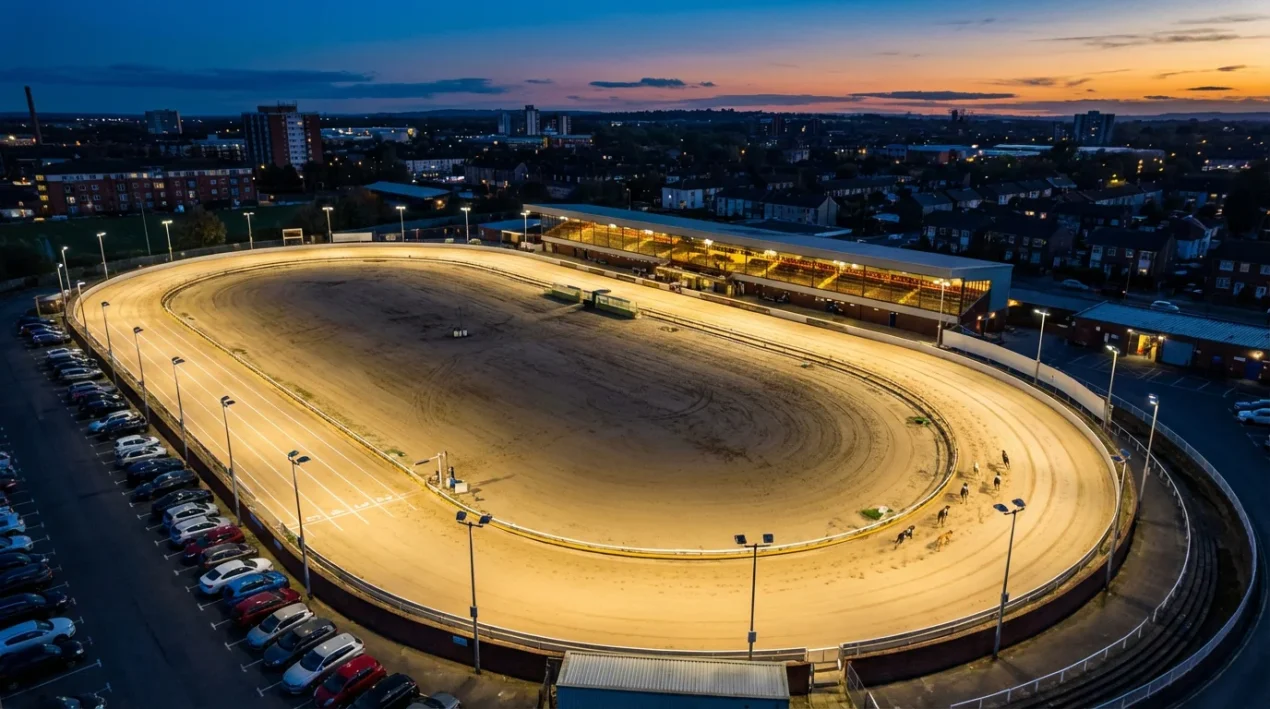
Nottingham is arguably the best galloping track in the country. The circuit is one of the largest in the UK, with wide, sweeping bends that give dogs genuine room to race. The standard distances are 305m, 480m, and 500m. What makes Nottingham distinctive is that the generous bends reduce the first-bend scrimmaging that blights racing at tighter tracks. Dogs can find their stride more naturally, and the result is that class tends to tell here more clearly than at many other venues. For bettors, Nottingham is often the track where form proves most reliable, particularly over the 480m trip. Wide runners that would struggle at Romford can express their full ability at Nottingham, and that difference in suitability is one of the most exploitable angles in track-by-track analysis.
Monmore Green in Wolverhampton is one of the busiest tracks in the country. It hosts frequent meetings, both evening and BAGS, and the conveyor belt of racing means there is always fresh form to work with. The track is medium-sized with reasonably fair bends, and distances include 264m, 480m, and 630m. Monmore does not have the extreme biases of the tighter London circuits, but inside traps still carry a small edge on the shorter trips. The volume of racing here makes it a favourite among punters who like to specialise at one venue and build detailed knowledge over time.
Perry Barr in Birmingham offers another Midlands option with its own character. The track hosts a mix of graded and open events, and its proximity to other Midlands venues means that dogs frequently move between Perry Barr, Monmore, and Nottingham. Tracking a dog’s performance across these different circuits can reveal useful information about its adaptability and genuine ability level.
South West and Beyond
Towcester in Northamptonshire is unique among UK greyhound tracks. It was built inside Towcester Racecourse’s horse racing circuit, making it the first new greyhound track to open in Britain since 1995 when it launched in December 2014 (Towcester Racecourse). The 420-metre circumference oval features wide, sweeping bends and long straights that create a distinctive racing dynamic. The standard distances include 260m, 480m, and 655m. The generous bends mean the track can accommodate eight-dog races, and dogs that handle the open layout tend to prosper. Towcester hosts the English Greyhound Derby and has become a flagship venue for punters who enjoy the analytical challenge of a high-quality, galloping circuit.
Swindon offers a more conventional layout with a fair-sized circuit that rewards honest runners. It runs regular meetings and has standard distances that provide a consistent test. Oxford Stadium, after a period of closure from 2012, reopened for greyhound racing in 2022 and now stages regular meetings including the prestigious Pall Mall Stakes (Oxford Stadium). Its return has strengthened the racing landscape outside London and the Midlands.
Henlow in Bedfordshire and Yarmouth on the east coast round out the wider picture. These are primarily BAGS tracks that serve the daytime betting market, and while they may lack the profile of the evening flagship venues, they offer steady racing with form that can be studied and exploited. The smaller fields at some BAGS meetings can actually work in a punter’s favour, as there is less interference and the better dog on the day tends to win more often.
Choosing your track is one of the first strategic decisions you make as a greyhound punter, and it is one of the most overlooked. The temptation is to bet on every meeting across the country, but the punters who consistently find value are usually those who know two or three tracks inside out. They understand how the bends affect wide runners, where the trap bias lies, which distances suit which types of dog, and how the going changes in the rain. That depth of knowledge cannot be replicated by scanning a racecard five minutes before the off.
Pick a couple of tracks. Watch the racing, even when you are not betting. Build a mental map of how races unfold at those venues. The rest of the country can wait. The track you know well is worth more than the ten you know superficially.