How to Analyse Greyhound Form: Expert Guide to Reading Cards
Best Greyhound Betting Sites – Bet on Greyhounds in 2026
Loading...
Contents
Form Is the Foundation
Every dog tells a story in numbers and abbreviations. The form card is where that story is recorded—compressed, coded, and available to anyone willing to learn the language. Ignoring form in greyhound betting is like ignoring a company’s financial statements before buying its shares. You might occasionally get lucky. You will more often get burned.
Greyhound form analysis involves reading a dog’s recent racing history and extracting information that predicts future performance. The components are consistent across all UK tracks: finishing positions in recent runs, times recorded over the course distance, positions at critical points during each race (first bend, back straight, final bend), running comments from the racing manager, and contextual data like trap draw, grade, and weight. Each of these elements reveals something different. Finishing positions tell you whether a dog is winning. Times tell you whether it is fast. Race comments tell you why it finished where it did—whether it led and faded, was baulked at the first bend, or ran on strongly from behind.
The primary sources for greyhound form data in the UK are the Racing Post, which publishes detailed racecards and form for every GBGB meeting, and the Greyhound Board of Great Britain itself, which maintains the official record of registered greyhound results. Individual track websites occasionally publish their own form data, though consistency and depth vary. For serious form study, the Racing Post remains the standard reference—its racecard format has been refined over decades and packs an extraordinary density of information into a compact layout.
Form analysis is not prediction. A dog with excellent recent form can encounter interference, miss the break, or simply have an off night. What form analysis does is tilt the probabilities. It identifies dogs whose recent performance, pace profile, and competitive context make them more likely to run well than the market currently implies. That margin—the gap between a dog’s true chance and its perceived chance—is where value lives. And finding value consistently is the only path to long-term profit.
Anatomy of a Greyhound Racecard
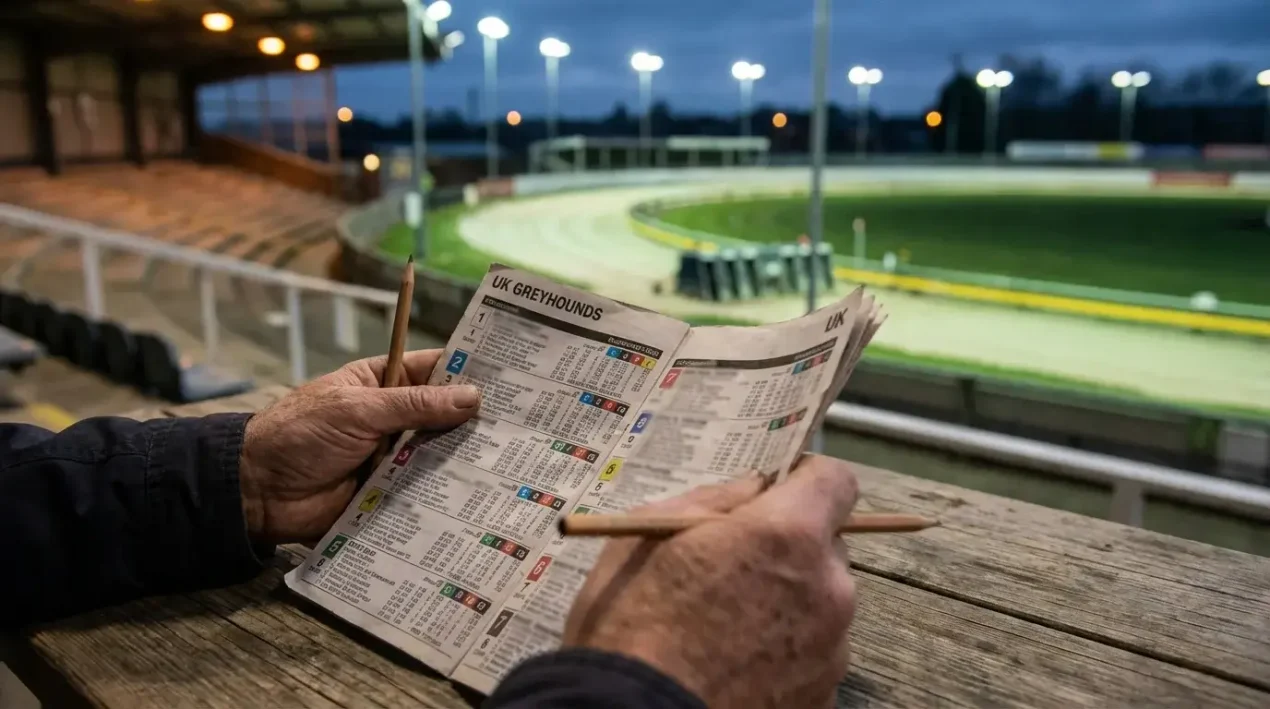
The racecard is your exam paper—learn to read it. A standard UK greyhound racecard contains more actionable information per square centimetre than almost any other sporting document. Every element is there for a reason, and overlooking even one can cost you money.
At the top of each entry sits the dog’s name, trap number, and trap colour. UK greyhound traps follow a universal colour code: trap 1 is red, trap 2 is blue, trap 3 is white, trap 4 is black, trap 5 is orange, and trap 6 is striped (black and white). These colours are not decorative—they allow spectators and punters to identify dogs during the race, and they correspond to the physical starting positions that significantly affect race dynamics.
Below the name, you will find the dog’s age, weight, sex, sire, dam, and trainer. Age is recorded in months, and for betting purposes it matters: greyhounds typically peak between 24 and 42 months, with most champions showing their best form around the 30-month mark. Weight fluctuations between runs can indicate fitness changes—a dog running significantly heavier or lighter than its recent average warrants investigation. The trainer name links to kennel form, which can reveal preparation patterns and track preferences.
The form line is the heart of the racecard. It displays the dog’s most recent runs in reverse chronological order, typically the last six to eight races. Each run is represented as a string of numbers and letters encoding the finishing position, positions at each bend, the time recorded, the grade, and any racing comments. A form line reading “2111 29.87 A3” tells you the dog was second at the first bend, led at every subsequent checkpoint, and finished first in a time of 29.87 seconds in an A3 graded race. The information density is remarkable once you learn to parse it.
Racecards also include calculated times, which adjust raw finishing times to account for going conditions and other variables, providing a more accurate basis for comparing performances across different meetings. The difference between raw time and calculated time can be significant on heavy or fast-running tracks, and ignoring calculated times means you are comparing performances measured under different conditions—which is roughly as useful as comparing a sprinter’s 100-metre time run into a headwind with one run on a still day.
Decoding Form Abbreviations
Every letter carries meaning. Greyhound racecards use a standardised set of abbreviations that describe what happened during a race far more precisely than the finishing position alone. Mastering these abbreviations turns a wall of letters into a narrative.
Running style indicators appear as single letters: R denotes a railer, a dog that naturally seeks the inside rail; M indicates a middle runner; W marks a wide runner that drifts to the outside. These are not fixed attributes—dogs can vary their running line depending on the trap draw and the pace around them—but the predominant style recorded across multiple runs reveals a dog’s natural tendency, which becomes critical when assessing trap draws.
Race comments are compressed descriptions of key incidents. “Ck” means checked—the dog was impeded during the race and lost momentum. “Bmp” indicates bumped, a less severe form of interference. “Led” means the dog led at the relevant point. “RnOn” (ran on) describes a dog that finished strongly without winning, often signalling improving fitness or a pace profile that suits longer distances. “Crd” (crowded) tells you the dog was squeezed for room, typically at a bend. “SAw” (slow away) means the dog missed the break from the traps, losing critical ground in the opening strides.
Grade designations accompany each run: A1 through A11 in descending quality, plus OR for open races and various category designations for higher-class events. A dog’s progression through grades—rising after good form, dropping after poor results or to be placed in a more suitable competition level—provides context that raw times cannot. A 29.50-second run in an A2 race is a fundamentally different performance from the same time in an A8. The opposition quality, and therefore the standard being measured against, changes everything about how to interpret the numbers.
Understanding Sectional Times
Sectionals separate the quick starters from the strong finishers. While the overall race time tells you how fast a dog completed the distance, sectional times reveal how that speed was distributed—and that distribution is often more predictive of future performance than the headline figure.
UK greyhound tracks typically record a split time at the first bend, which captures the dog’s early pace from trap to the initial turn. This first-bend split is arguably the single most important number on the racecard, because the majority of greyhound races are won by the dog that reaches the first bend in front. The physics are straightforward: six dogs funnelling into a turn creates interference for those behind, and once clear air opens up for the leader, maintaining that advantage requires less energy than overcoming it from behind.
The run-in time—from the final bend to the finishing line—reveals a dog’s finishing stamina. Some dogs produce blistering early splits but fade in the closing stages, suggesting they are better suited to shorter distances or require an uncontested lead. Others show moderate early pace but strong closing times, indicating they finish well once the pace ahead relents. For betting purposes, the latter type is often undervalued by the market, because casual punters focus on winners and overlook the dog that ran on strongly into second or third after a slow start caused by interference.
Comparing sectional times across different tracks requires caution. A first-bend split of 4.50 seconds at Romford, a tight 350-metre circuit, represents a very different physical achievement than the same split at Towcester, where the distances between trap and first bend differ substantially. Meaningful comparison demands track-specific benchmarks built from aggregate data. What constitutes a fast split at one venue may be average at another, and applying universal time standards across tracks is one of the most common analytical errors in greyhound form study.
The gap between calculated and actual sectional times also carries information. A dog whose calculated time is significantly faster than its actual time may have been affected by going conditions (a slow track, or a headwind into the home straight) that masked its true ability. Conversely, a fast actual time on a track running quick may flatter a dog whose true pace is more modest. Treating raw times as gospel without adjusting for conditions is the analytical equivalent of navigating without checking the weather forecast.
Pace Analysis and First Bend Advantage
Win the bend, win the race—most of the time. Statistical studies across UK tracks consistently show that the dog leading at the first bend wins the race in approximately 60-70% of cases, depending on the track and distance. At tighter circuits like Romford, where the first bend arrives quickly and the room for manoeuvre is limited, that figure climbs higher still.
Identifying fast breakers is therefore one of the most productive form analysis skills a greyhound bettor can develop. The first-bend split time, combined with trap draw, gives you a strong indication of which dog is most likely to reach the first turn in front. A dog with consistently fast early splits drawn in an inside trap (1 or 2) at a track where inner traps enjoy a short run to the first bend starts with a tangible structural advantage. The same dog drawn wide, with farther to travel, may find its early speed neutralised by the geometry of the track.
Split time benchmarks vary by track distance. For standard 480-metre races at most circuits, a first-bend split under 4.50 seconds indicates genuine early pace, while anything above 4.80 suggests a moderate starter. At 265 metres—sprint distance—the margins compress, and tenths of a second become decisive. Building a reference table of fast, average, and slow splits for each distance at your chosen track takes perhaps an afternoon of data collection and saves months of guesswork.
One subtlety: early speed is not the same as breaking speed. A dog can break fast from the traps but be slow to gather pace through the initial straight, or break moderately but accelerate quickly into the bend. The first-bend split captures the net result, but watching replays of a dog’s trap breaks—available through bookmaker streaming or track archives—adds a layer of insight that numbers alone cannot provide.
Running Styles: Railers, Wides, and Middle Runners
A wide runner crammed against the rail is a dog fighting its instincts. Understanding running styles—and how they interact with trap draws—is one of the most practical edges available to greyhound form analysts, yet it remains underused by the betting public.
Railers are dogs that naturally gravitate toward the inside rail once the race begins. They seek the shortest route around the bends, which in theory covers less ground than any other running line. The trade-off is vulnerability to crowding: if a railer encounters traffic on its inner shoulder, it has nowhere to go except behind or through. Railers drawn in traps 1 and 2 enjoy a natural advantage because they start closest to their preferred racing line. A railer drawn in trap 5 or 6 must cross the path of several rivals to reach the rail, losing ground and inviting interference in the process.
Wide runners take the opposite approach, swinging to the outside of the field around the bends. This covers more ground—geometrically, the outside of a curve is always longer than the inside—but provides cleaner racing room. Wide runners drawn in traps 5 and 6 can sweep around the first bend without obstruction, maintaining momentum while dogs on the inner fight for position. The optimal scenario for a wide runner is a pace battle on the inside that creates space for an unopposed run around the outside.
Middle runners are the pragmatists. They can adjust their line depending on the pace and traffic around them, which makes them versatile but also harder to predict. A middle runner’s performance is more dependent on the dynamics of the specific race—who breaks fast, who crowds whom at the first bend—than on any fixed tactical approach. This makes middle runners interesting from a value perspective, because the market often struggles to price in their adaptability.
Conflict scenarios arise when multiple dogs with the same running style are drawn in adjacent traps. Two railers drawn in traps 1 and 2 will contest the rail from the outset, which frequently leads to interference that benefits dogs running wider. Two wide runners in traps 5 and 6 can push each other wider still, covering extra ground and tiring through the final stages. Identifying these clash points on the racecard before the race is one of the simplest and most reliable form analysis techniques. It requires no data beyond running style designations and trap draws, both of which are printed on every racecard.
Matching Style to Trap Draw
The Racing Manager sets the puzzle—you solve it. At every GBGB track, the Racing Manager is responsible for seeding dogs into traps based on their running style, recent form, and grade. The aim is to produce competitive, safe racing, but the allocation is not always perfectly balanced, and the mismatches it creates are where betting value frequently hides.
The optimal pairings are intuitive: railers from traps 1-2, middle runners from traps 3-4, wide runners from traps 5-6. When the trap draw aligns with running style, a dog can execute its natural race pattern without adjustment, conserving energy and avoiding interference. When the draw contradicts the style, problems follow. A railer in trap 6 must expend effort crossing the field to reach the rail, typically losing two or three lengths in the process—and in a sport where races are decided by fractions of a second, that deficit is frequently unrecoverable.
Red flags on a racecard include any of the following: a confirmed railer drawn in trap 5 or 6, a wide runner drawn in trap 1 or 2, or two dogs with the same running style drawn adjacently in positions that will force them into each other’s path. These situations do not guarantee poor performance, but they increase the probability of trouble sufficiently to justify either opposing the dog or, at minimum, requiring longer odds to compensate for the additional risk.
Green flags are the inverse: a fast-breaking railer in trap 1 at a track with a short run to the first bend, or a proven wide runner in trap 6 at a circuit with sweeping turns that reward the outside line. When running style, trap draw, and track characteristics all align, the dog has every structural factor working in its favour. The market usually accounts for some of this advantage, but not always fully, particularly in lower-grade races where casual punters pay less attention to tactical dynamics.
The Grading System Explained
Grades aren’t just labels—they’re competitive context. The UK greyhound grading system exists to ensure competitive races by grouping dogs of similar ability, but for the form analyst, it functions as a layered map of quality that reveals far more than most punters extract from it.
The system runs from A1 (the highest standard of regular graded racing) down to A11, with each grade representing a step down in expected performance level. Open races sit above the graded structure, subdivided into categories that range from the very best dogs in training down to competitive animals just above the top graded level. The grade assigned to a dog reflects its recent times and finishing positions at a specific track, adjusted by the Racing Manager to maintain field quality.
Grade movements are where the analytical value lies. A dog promoted from A4 to A3 is now competing against faster opposition, and its form in the lower grade may not be reproduced against stronger rivals. The promotion tests whether the dog truly belongs at the higher level, and early runs after a grade rise are often instructive—a dog that finishes within a length of the winner in its first A3 outing after dominating A4 is genuine. A dog that trails in last may have hit its ceiling.
Grade drops work in reverse and are frequently more interesting from a betting perspective. A dog moved from A3 to A4 may have been struggling against the stronger grade, but dropping into easier company can revive its form dramatically. The key is distinguishing between a drop driven by a temporary form dip—perhaps caused by a poor trap draw, interference, or minor injury recovery—and a drop driven by genuine decline. Recent sectional times are the best diagnostic tool here. A dog whose times have deteriorated steadily over several runs is likely declining. A dog whose overall times look poor but whose sectional splits remain competitive may simply have been unlucky with race dynamics.
Home track advantage deserves specific mention. Dogs race most frequently at their registered track, where they are familiar with the track surface, the hare system, the trap mechanism, and the bend profiles. When a dog runs at an away track, even at the same grade, its performance can differ materially. The racecard will indicate whether each run was at the current track or elsewhere, and a form line dominated by home-track runs in a familiar grade is generally more reliable as a predictor than one cobbled together from performances at three different venues.
Spotting Value in Class Drops
A drop in class can mean a rise in value—but not always, and the distinction matters.
Dogs drop grades for various reasons. A trainer might rest a dog and see it return to a lower grade due to the grading rules penalising absence. A dog might have encountered repeated interference in its recent runs, producing poor finishing positions that triggered an automatic demotion despite the underlying ability remaining intact. Kennel tactics also play a role: some trainers deliberately allow a dog to drop a grade through moderate performances before targeting a specific race at the lower level where the prize money or competitive dynamics suit them.
The value signal is strongest when a grade drop coincides with maintained or improving sectional times. If a dog has dropped from A3 to A4 but its first-bend splits and calculated times from recent runs remain at A3 level, the drop likely reflects circumstances (poor draws, interference, breaks in training) rather than declining ability. This dog is running A3 times in A4 company, and the market often fails to account for this fully because the headline form—recent finishing positions—looks unimpressive.
The danger signal is equally clear. A dog whose times have progressively slowed across its last four or five runs, whose finishing positions have deteriorated from winning to midfield, and which is now dropping a grade is not a value proposition. It is a dog in decline, and a grade drop into easier company may arrest the slide temporarily but will not reverse the underlying trend. Weight increases without explanation, lengthening gaps between runs, and a shift from front-running to mid-pack finishes all corroborate the decline narrative. Back these dogs at your peril, regardless of how attractive the odds appear.
Trainer and Kennel Form
Behind every dog is a trainer with a track record. Greyhound training in the UK is a specialist profession, and the quality gap between the best and the rest is wider than many punters appreciate. A dog’s trainer influences its fitness, preparation, race readiness, and competitive placement—all of which affect betting outcomes.
Kennel strike rates vary considerably. Some trainers consistently produce runners that outperform their market odds, while others run large strings of dogs with mediocre overall statistics. Tracking trainer performance over a meaningful sample—at least fifty runners—reveals patterns that individual dog form cannot. A trainer running at a 22% strike rate when the market-implied average for their runners is 15% is adding value through preparation, and dogs from that kennel deserve closer attention even when their individual form looks modest.
Trainer-track combinations are particularly revealing. Most trainers base themselves near one or two tracks and run the majority of their dogs at those venues. Familiarity with track conditions, relationships with Racing Managers, and experience with the local grading patterns all contribute to a home-track advantage that extends beyond the individual dog to the entire kennel operation. A trainer with a strong record at Nottingham sending a dog to Romford for the first time is operating outside their primary environment, and the dog’s performance may not match what its home-track form suggests.
Following in-form handlers is a practical shortcut that requires minimal data. The Racing Post publishes trainer statistics, and most form databases allow filtering by kennel. When a trainer’s runners are consistently finishing in the places or producing faster-than-expected times across multiple dogs, it typically indicates that the kennel’s preparation is peaking—perhaps due to good health across the string, a skilled trials regime, or simply a favourable period in the grading cycle. This macro trend is easier to spot than individual dog form and often persists for weeks before reverting.
Form as Conversation
Form is the beginning of analysis, never the end. A racecard tells you what happened. It does not tell you what will happen. The distinction is not pedantic—it is the difference between using form as a tool and treating it as a crystal ball.
The best form analysts approach each racecard as a conversation between data and context. The numbers establish a baseline: this dog runs at this pace, from this position, at this level. The context adds nuance: was the last run affected by interference? Has the trap draw improved? Is the trainer’s kennel in a productive spell? Does the dog’s running style suit the track geometry tonight? Each layer of context adjusts the baseline, sharpening the picture without pretending it will ever be perfectly clear.
Continuous learning is not optional. Track conditions change, grading cycles shift, new dogs arrive and established ones retire. A form analysis method that worked well last month may need refinement next month. Keep records of your assessments and compare them against results—not just whether the dog won, but whether your reading of the form was directionally correct. A dog you backed to finish in the first two that finished third after interference is a better outcome for your analysis than a lucky winner you backed on a hunch. The process matters more than any individual result, because the process is what survives across hundreds of bets.
Form rewards the patient. It punishes the impatient and the lazy in roughly equal measure. Learn the language of the racecard, build your reference points track by track, and resist the temptation to bet on races where the form picture is genuinely unclear. The clearer your reading, the sharper your edge—and in greyhound betting, every fraction of edge counts.